Citykart Reaches 200 Stores, Adds Its Next 100 Outlets in Just 36 MonthsCitykart has reached the 200-store milestone, marking a sharp acceleration in its retail expansion as the value-fashion retailer deepens its presence across India’s Tier-II, Tier-III and Tier-IV markets.
Citykart has reached 200 stores across India, marking a significant milestone in the growth journey of the value-fashion retailer and highlighting the increasing importance of smaller Indian cities in the country’s organised retail market.
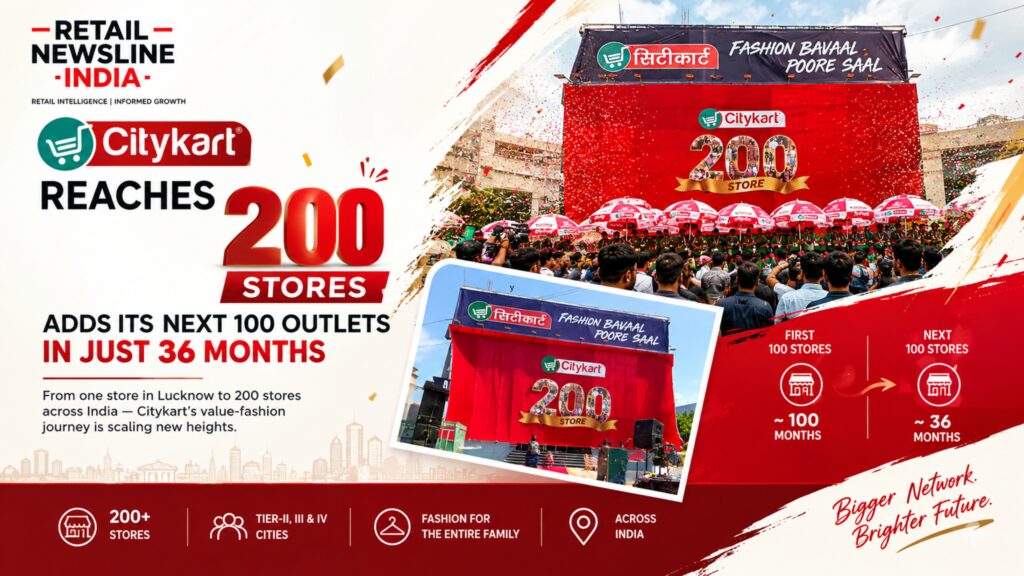
The company has highlighted the pace of its expansion as one of the key achievements behind the milestone. According to Citykart, it took nearly 100 months to build its first 100 stores, while the company added its next 100 stores in just 36 months.
The acceleration reflects Citykart’s strategy of building a large-format family fashion retail network in markets where consumers are increasingly seeking organised retail, branded fashion and affordable products closer to home.
Citykart’s latest milestone announcement also acknowledged the role of co-founders Sudhanshu Agarwal and Rohit Agarwal, along with the wider team, in driving the company’s expansion.
Citykart’s 200-Store Milestone Signals Faster Retail Expansion
The journey from the first 100 stores to 200 stores in 36 months is particularly significant because Citykart has built its network largely around India’s non-metro consumption markets.
Citykart was established in 2015 by Citykart Retail Ventures and opened its first store in Lucknow in 2016. The company says its business was created around the opportunity in Tier-II and Tier-III apparel markets, where consumers had growing aspirations but comparatively limited access to organised fashion retail.
Over the years, the retailer has expanded beyond apparel to create a broader family-shopping proposition covering men’s fashion, women’s fashion, kidswear, footwear, accessories, home furnishings, toys, general merchandise and utility products.
Its latest 200-store announcement therefore represents more than a store-count milestone. It demonstrates how value-oriented organised retail is expanding beyond India’s major metropolitan markets.
From 100 Stores to 200: Citykart’s Expansion Accelerates
The company’s milestone can be viewed through two distinct phases.
First 100 stores: approximately 100 months
Next 100 stores: approximately 36 months
This means the retailer significantly increased its pace of store additions as its operating model, sourcing capabilities, customer understanding and market strategy matured.
Citykart’s own website currently records a progression from 14 stores in 2016 to 154 stores in 2025 and 190+ stores in 2026, although the website has yet to reflect the latest 200-store announcement. (CityKart)
The company’s current public announcement of 200 stores should therefore be treated as the latest milestone, while the website’s 190+ figure appears to be awaiting an update.
Citykart’s Bigger Bet on Bharat
A major differentiator in Citykart’s expansion strategy has been its focus on India’s smaller cities.
The company’s current store locator lists presence across states including Uttar Pradesh, Bihar, Chhattisgarh, Jharkhand, Madhya Pradesh, Odisha, Assam, Tripura, Rajasthan, Arunachal Pradesh, Jammu & Kashmir, Delhi and Nagaland.
Fortune India reported in July 2026 that Citykart had reached 179 stores across 156 cities, with the retailer focusing heavily on Tier-III and Tier-IV markets. The publication described the company’s strategy as an attempt to capture the consumption opportunity emerging outside India’s major metros.
This positioning is important because India’s retail growth is increasingly spreading beyond metros. Consumers in smaller cities are becoming more fashion-conscious while also remaining highly value-sensitive.
For Citykart, that creates an opportunity to combine fashion, affordability, family shopping and convenience in a single physical retail format.
Sudhanshu Agarwal and Rohit Agarwal’s Citykart Vision
Citykart’s expansion has been closely associated with its directors and co-founders Sudhanshu Agarwal and Rohit Agarwal.
According to Citykart’s official team profile, Sudhanshu Agarwal identified a significant gap in the Tier-II and Tier-III apparel market and developed the Citykart retail concept around providing fashion and home-related products at accessible prices. He also previously worked with Vishal Mega Mart as a vice president.
Rohit Agarwal has been associated with merchandising, product development, sourcing and design. Citykart says he works with more than 250 vendors and brings a focus on fashion, fabric, data analysis and competitive pricing to the business.
The complementary focus on retail execution, merchandising, sourcing, data and pricing has been central to Citykart’s value-fashion proposition.
₹538 Crore Funding Strengthened Citykart’s Expansion Engine
Citykart’s accelerated expansion also follows a major capital raise in 2025.
In May 2025, the company raised ₹538 crore in a Series B funding round co-led by TPG NewQuest and A91 Partners. The transaction included approximately ₹120 crore of primary capital, while ₹418 crore came through secondary transactions. Investcorp exited its investment completely, while India SME Fund retained a minority stake.
At the time of the funding announcement, Citykart had 137 stores across 91 cities in 11 states and was serving more than 15 million customers annually. The company was growing at more than 40% and had set a target of crossing ₹1,300 crore in revenue.
The fresh capital was intended to support expansion in store footprint and product assortment, while also strengthening Citykart’s organisational and operational capabilities.
The subsequent move from 137 stores in May 2025 to the latest 200-store milestone illustrates the pace at which the retailer has continued to scale.
Citykart’s Private-Label Strategy
Another important component of the business is its private-label portfolio.
Citykart operates in-house brands including Athiya, Nimes, Fumee and Remise, allowing it to develop products specifically for the value-fashion consumer.
Private labels can provide retailers with greater control over product design, sourcing, pricing and assortment. For a value-fashion business operating across diverse markets, this can be particularly important because consumer preferences can vary considerably from one region to another.
Citykart’s proposition is built around providing multiple categories under one roof rather than positioning itself solely as an apparel retailer.
What Citykart Sells
Citykart’s family-oriented retail model spans several categories.
Its portfolio includes:
- Men’s apparel
- Women’s apparel
- Boys’ and girls’ fashion
- Kidswear
- Footwear
- Fashion accessories
- Home furnishings
- General merchandise
- Toys
- Household and utility products
The company describes its proposition as fashion and everyday shopping for the entire family.
This broader assortment helps Citykart increase the relevance of its stores for family shopping rather than limiting the customer visit to a single apparel category.
Why Tier-II, Tier-III and Tier-IV Cities Matter to Citykart
Citykart’s growth story is closely connected to a broader shift taking place in Indian retail.
For years, organised fashion retail expansion was concentrated in metros and large Tier-I cities. However, smaller cities are increasingly becoming important consumption markets as disposable incomes, aspirations, digital exposure and access to organised retail improve.
Fortune India’s reporting on Citykart highlighted the company’s presence in markets such as Darbhanga, Chapra and Raebareli, illustrating its willingness to build stores in locations that have traditionally received less attention from large organised retailers.
The company’s strategy is consequently not simply about adding stores. It is about building a retail network around a particular consumer proposition: affordable fashion for India’s aspirational middle-income families.
Citykart’s Store Expansion Model
Citykart’s latest milestone also shows the importance of replicability in physical retail.
Moving from 100 to 200 stores within 36 months requires a retailer to standardise several parts of the operating model, including:
- Store identification and location selection
- Merchandise planning
- Vendor and sourcing management
- Inventory allocation
- Supply-chain operations
- Store construction and rollout
- Hiring and training
- Local marketing
- Pricing and promotions
- Customer acquisition and retention
Citykart’s ability to increase its store-opening pace indicates that these processes have become increasingly scalable.
The company itself highlights data and analysis as part of its management approach, while its founders’ profiles emphasise merchandising, sourcing and decision-making.
Citykart’s Customer Proposition: Fashion at Value Prices
At the heart of Citykart’s business model is a relatively straightforward proposition: make fashion accessible to families outside India’s largest cities without requiring them to travel to major urban retail destinations.
The company describes itself as a value-fashion chain and highlights quality, reliable pricing, fashion trends and aspirational shopping experiences as elements of its differentiation.
Its current website positions the brand around fashion for Indian families and specifically highlights its presence in Tier-II, Tier-III and Tier-IV cities.
This combination of affordability and physical accessibility could remain an important growth driver as organised retail penetrates deeper into Bharat.
From 137 Stores in 2025 to 200 Stores in 2026
Citykart’s recent growth can be understood against its funding and expansion trajectory.
| Period | Key milestone |
| 2015 | Citykart established |
| 2016 | First store opened in Lucknow |
| 2023 | More than 100-store scale reached |
| May 2025 | 137 stores across 91 cities and 11 states |
| July 2026 | Fortune India reported 179 stores across 156 cities |
| September 2026 | Citykart announces 200 stores |
The figures come from different company and media snapshots, so they should not be interpreted as a single audited year-end series. However, together they show the retailer’s rapid expansion over the past few years.
What Comes After 200 Stores?
The 200-store milestone is unlikely to be the endpoint for Citykart.
The company has previously communicated an ambition to reach 300 stores, while its LinkedIn company profile has also positioned 300+ retail outlets as a longer-term objective.
The more important question now is how Citykart balances store expansion with store productivity, customer retention, merchandise margins, inventory efficiency and profitability as its network becomes larger.
The company’s 2025 funding round was specifically intended to support deeper and wider expansion, product assortment and operational capabilities.
With 200 stores now reached, the next stage will test Citykart’s ability to replicate its value-fashion model across an even broader geographic footprint.
Citykart’s 200-Store Milestone Is Bigger Than a Store Count
The significance of Citykart reaching 200 stores lies in the speed and geography of the expansion.
The company has gone from building its initial retail network over several years to adding the next 100 stores in just three years. More importantly, much of this growth has taken place in the smaller cities that are becoming increasingly important to India’s consumption story.
For organised retail, Citykart’s journey offers a clear indication of where the next wave of fashion demand could emerge.
The first 100 stores established the model. The next 100 demonstrated the ability to scale it. The next phase will determine how far that model can travel across Bharat.
Frequently Asked Questions
How many stores does Citykart have?
Citykart has announced that it has reached 200 stores across India. Its official website’s establishment page currently shows 190+ stores, indicating that the website is yet to be updated following the latest milestone announcement.
When was Citykart founded?
Citykart was established in 2015 by Citykart Retail Ventures, with its first store opening in Lucknow in 2016.
Who are the founders of Citykart?
Citykart was founded by Sudhanshu Agarwal and Rohit Agarwal, who continue to be associated with the company’s leadership.
Where does Citykart operate?
Citykart has a strong presence across Tier-II, Tier-III and Tier-IV markets, with its store locator listing states including Uttar Pradesh, Bihar, Jharkhand, Chhattisgarh, Madhya Pradesh, Odisha, Assam, Rajasthan, Tripura, Nagaland and others.
What products does Citykart sell?
Citykart sells men’s, women’s and kids’ fashion along with footwear, accessories, home furnishings, toys, general merchandise and household utility products.
How much funding did Citykart raise in 2025?
Citykart raised ₹538 crore in Series B funding, co-led by TPG NewQuest and A91 Partners.
What are Citykart’s private labels?
Citykart’s private-label portfolio includes Athiya, Nimes, Fumee and Remise.
What is Citykart’s expansion strategy?
Citykart’s strategy centres on expanding value-fashion retail across India’s underserved Tier-II, Tier-III and Tier-IV markets, while increasing its store network, product assortment and geographic reach.