
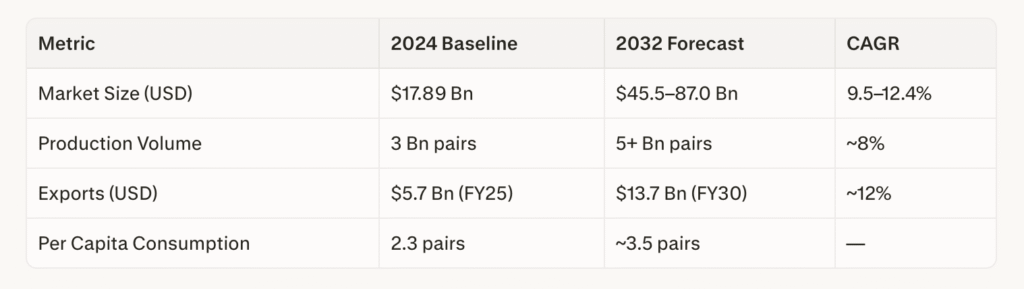
India’s footwear sector is undergoing a transformative expansion, evolving from a fragmented, traditional manufacturing base into a dynamic, innovation-led global powerhouse. Valued at $17.89 billion in 2024, the domestic market is projected to surge to $45.5 billion by 2032, registering a robust Compound Annual Growth Rate (CAGR) of 12.39%. With production hitting 3 billion pairs annually and exports crossing $5.7 billion in FY25 (a 25% YoY jump), India is firmly establishing itself as the world’s second-largest footwear producer after China.
Quick Answer: The Indian footwear market is growing at 12.39% CAGR, driven by rising incomes, a youth boom, and government PLI schemes, with exports targeting $13.7 billion by 2030.
1. Market Size and Growth Trajectory: Data-Driven Forecasts
The industry’s momentum is undeniable, fueled by urbanization and premiumization. From a modest base, per capita consumption has risen from 1.7 pairs (2016) to 2.3 pairs (2021), eyeing 3.5 pairs by 2030. Conservative estimates place the 2025 valuation at $20.67 billion, projecting a rise to $47.53 billion by 2034 at a 9.7% CAGR. Optimistic scenarios, factoring in export scaling and luxury adoption, forecast a massive $87 billion by 2032.
Exports: The New Growth Engine
Exports have been a standout performer, jumping 25% year-on-year to $5.7 billion (₹48,667 crore) in FY25, surpassing government targets by $1 billion. The Council for Leather Exports (CLE) projects this figure to cross $6.5 billion in FY26, driven by strong demand from the USA, UK, Germany, and UAE. Long-term, the industry aims for a $39 billion total turnover by 2030, comprising $25 billion in domestic sales and $13.7 billion in exports.
Key Market Metrics (2024–2032)
2. Key Growth Drivers: Why India Now?
2.1 Rising Disposable Incomes and Urbanization
India’s per capita income, now approaching $3,200, is fueling a structural shift from unbranded, utility footwear to branded, fashionable options. The expanding middle class, projected to exceed 600 million urban residents by 2030, is driving demand across casual, sports, and luxury segments.
2.2 Youth Demographic and Western Influence
With 371 million youth (aged 15–29)—the world’s largest such demographic—India’s footwear market is heavily influenced by global trends, social media, and celebrity endorsements. Sports footwear, in particular, is seeing double-digit growth as fitness consciousness rises, with athleisure becoming a daily uniform.
2.3 Government Support: Make in India, PLI & $1B Package
Policy tailwinds are unprecedented:
- Production Linked Incentive (PLI) Scheme for leather products boosts machinery upgrades and export competitiveness.
- A fresh $1 billion manufacturing package (2026) covers the entire value chain, addressing US tariff challenges.
- Dedicated footwear clusters in Tamil Nadu, Andhra Pradesh, and West Bengal enhance logistics and reduce costs.
- Bureau of Indian Standards (BIS) norms (effective April 2025) ensure quality, curbing cheap imports.
2.4 The Non-Leather Revolution
Non-leather (synthetic and vegan) footwear is reshaping the landscape, projected to grow from 25% to 75% of the $90 billion market by 2030. This shift caters to cost-conscious, style-aware, and ethically minded consumers, positioning India as a global hub for sustainable footwear.
3. Emerging Trends and Innovation: The Future is Now
3.1 D2C Disruption and Omni-channel Retail
Direct-to-consumer (D2C) brands are rewriting the rules. Snitch, for instance, reported an 80% revenue surge to ₹900 crore in FY26, recently launching its debut sneaker line, 9691, priced at ₹2,499. Online channels now account for 60% of Snitch’s revenue, reflecting a broader industry shift toward e-commerce and quick commerce.
3.2 Sustainability and Tech Integration
Brands are increasingly adopting recycled materials, waterless dyeing, and circular economy models. Meanwhile, AI-driven design, augmented reality (AR) try-ons, and even smart footwear with health sensors are entering the innovation pipeline, positioning India at the forefront of footwear tech.
3.3 Component Manufacturing Push
The footwear components sector—covering soles, uppers, and adhesives—is expected to meet 50% of domestic demand by 2028, up from current levels, as the government promotes 10,000 new micro-suppliers. This localization is critical for reducing costs and improving competitiveness against Chinese imports.
4. Competitive Landscape: Who Leads the Pack?
The market remains fragmented but is consolidating around key listed and private players:
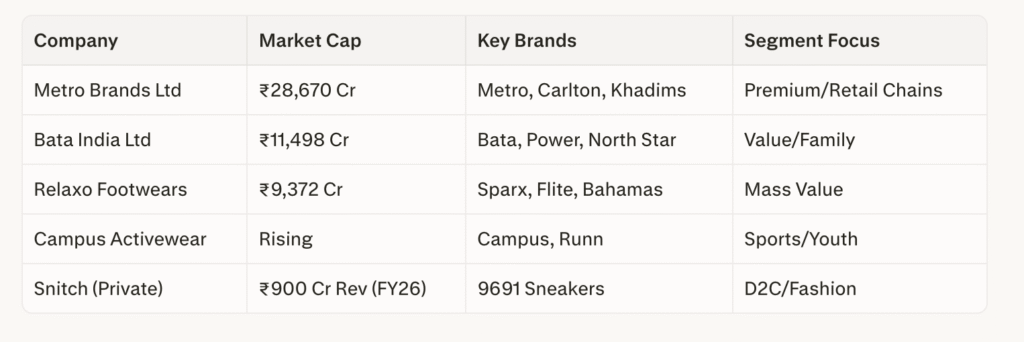
Emerging challengers like Red Tape, HRX, and Liberty are gaining share in the sports and casual categories.
5. Challenges and Roadblocks: A Balanced View
Despite the optimism, hurdles persist that investors must monitor:
- Capacity Constraints: Production has stagnated around 2.2–3 billion pairs due to MSME-focused policies and taxation burdens on organized players.
- Global Competition: India accounts for only 2.2% of global footwear exports, dwarfed by China’s dominance, though this gap is narrowing.
- Skill Gaps: Advanced manufacturing requires upskilling labor, a focus area for new government training programs.
- Import Pressure: Cheap imports from China and Vietnam continue to undercut domestic producers in the value segment.
6. The Road to 2030 and Beyond: Strategic Outlook
India’s footwear industry is well-positioned to become an $80–90 billion global hub by 2030, potentially supplying 10 billion pairs annually by 2040. Success will hinge on scaling production capacity, embracing sustainability, and leveraging digital tools to capture both domestic and export markets.
Expert Insight: As Chetan Siyal, CMO of SNITCH, noted during the 9691 launch: “Today’s urban man is constantly moving… The idea was to design a collection that fits seamlessly into that lifestyle”. This sentiment encapsulates the broader industry shift: footwear in India is no longer just about protection—it’s about identity, performance, and aspiration.
Frequently Asked Questions (FAQs)
Q: What is the CAGR of the Indian footwear market?
A: According to maximizemarketresearch, the market is growing at 12.39% CAGR from 2025 to 2032.
Q: Which segment is growing fastest?
A: Sports/Active footwear and Non-leather categories are leading with double-digit growth.
Q: How much are India’s footwear exports?
A: Exports hit $5.7 billion in FY25, targeting $6.5 billion in total.
Q: Who are the top footwear stocks in India?
A: According to groww, Metro Brands, Bata India, and Relaxo Footwears are the top-listed players by market cap.