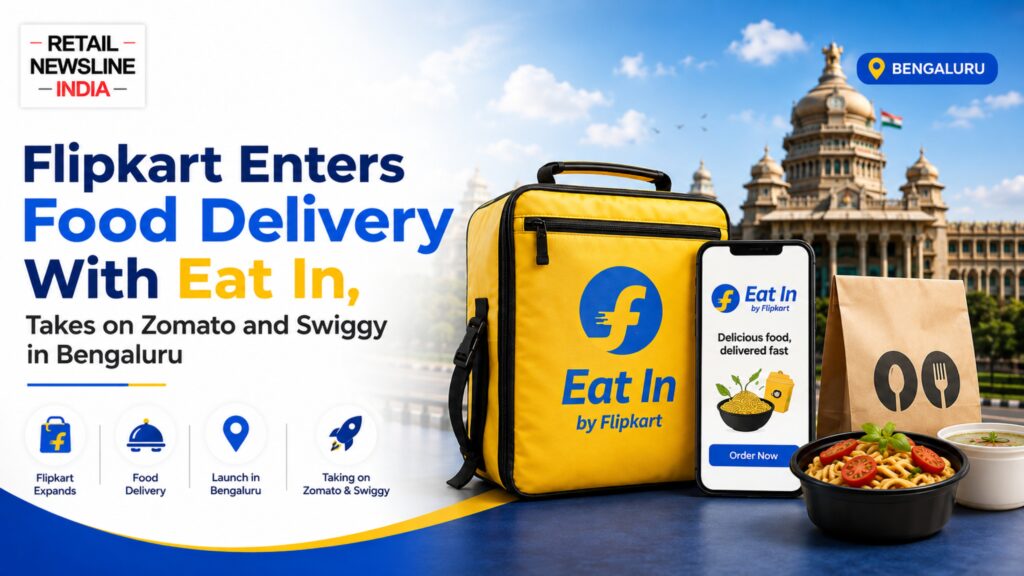
Flipkart is entering India’s food delivery market with Eat In, its new food-ordering service being tested among employees in Bengaluru. The Walmart-backed e-commerce company is preparing to take on established players such as Zomato and Swiggy, while newer models from Rapido’s Ownly and Swiggy’s Toing are reshaping competition around price, commissions and customer value.
According to reports, Flipkart is currently testing Eat In internally with employees in Bengaluru and is expected to expand the service to its wider employee base around September 15, 2026, before potentially opening it to consumers in the city.
The development marks another major expansion for Flipkart as it moves beyond traditional e-commerce into a broader consumer ecosystem that already includes categories such as quick commerce through Flipkart Minutes.
Flipkart Eat In: What We Know So Far
Flipkart’s food delivery initiative, reportedly called Eat In, is currently in its testing phase.
The initial rollout is focused on Bengaluru, allowing Flipkart to test the service with employees before exposing it to a broader consumer audience.
The expected rollout sequence is:
Employee testing → wider Flipkart employee access → Bengaluru consumer launch → potential expansion to other cities
The company had earlier indicated that it planned to test food delivery on a limited scale before deciding how aggressively to expand it across India. Flipkart Group CEO Kalyan Krishnamurthy said the company would test the proposition, gather customer feedback and improve the service before scaling.
This approach is significant because food delivery is operationally different from conventional e-commerce. Success depends not only on app technology but also on restaurant density, delivery availability, preparation times, logistics, customer support and repeat ordering.
Will Flipkart Food Delivery Be Available Inside the Main App?
Initially, Eat In is expected to be integrated into the main Flipkart ecosystem, rather than immediately becoming a completely independent consumer application.
This gives Flipkart an important potential advantage: it can leverage an existing customer base rather than building food-delivery traffic from zero.
A standalone food-delivery app could potentially be introduced later if the business scales, but the immediate strategy appears focused on testing the proposition and understanding consumer behaviour.
This is similar to the broader trend in India’s consumer internet market where companies are increasingly using their existing user bases to launch adjacent services.
For Flipkart, food delivery could become another customer use case within its larger commerce ecosystem.
Flipkart Is Building Eat In With ONDC
One of the most important aspects of Flipkart’s food-delivery strategy is its reported partnership with the Open Network for Digital Commerce (ONDC).
Earlier reports indicated that Flipkart planned to initially launch its food-delivery service through the government-backed ONDC network before potentially developing its own application and ecosystem.
The ONDC connection could allow Flipkart to participate in a more open digital-commerce environment instead of relying exclusively on a closed marketplace model.
For restaurants, the economics could become equally important.
Reports indicate that Flipkart is working toward a lower-commission model for restaurant partners, potentially giving restaurants an alternative to conventional food-delivery platforms.
That could become one of Eat In’s biggest differentiators.
Lower Commissions Could Be Flipkart’s Biggest Weapon
Food delivery has traditionally been a challenging business for restaurants because platform commissions, discounts, advertising costs and other charges can significantly affect restaurant economics.
Flipkart appears to understand that restaurant-side economics could be a key entry point.
Instead of simply competing with Zomato and Swiggy on discounts, Eat In could attempt to build a proposition around:
- Lower restaurant commissions
- Greater restaurant economics
- Competitive consumer pricing
- Wider restaurant selection
- Reliable delivery
- Integration with Flipkart’s existing ecosystem
- Potential ONDC-enabled network participation
This strategy would also put Flipkart closer to the structural changes currently taking place across India’s food-delivery industry.
Rapido’s Ownly Has Already Challenged the Traditional Model
Flipkart’s entry comes at a time when Rapido’s Ownly has demonstrated that restaurants and customers may be willing to experiment with alternative food-delivery models.
Ownly operates on a zero-commission model for restaurants, with delivery fees being used to support the logistics side of the business. Rapido formally launched Ownly across Bengaluru in March 2026 after an earlier pilot.
The platform’s growth has been particularly notable.
By August 2026, Ownly had reportedly crossed 50,000 food-delivery orders per day in Bengaluru, equivalent to roughly 10% of the city’s estimated 500,000–600,000 daily food-delivery orders.
That makes Ownly more than just an experimental challenger.
It also demonstrates that there may be room for alternative economics in India’s food-delivery market.
Ownly’s growth changes the competitive equation
Ownly’s proposition is relatively straightforward:
Zero restaurant commission + delivery fee + lower overall ordering economics
The platform’s rapid growth has increased pressure on established players to rethink restaurant relationships and pricing.
Rapido has also integrated Ownly into its main app, allowing users to access food delivery alongside its mobility services.
This creates an interesting parallel with Flipkart.
Both companies are using an existing consumer ecosystem to enter food delivery rather than relying solely on a standalone food application.
Swiggy Toing Is Fighting the Affordability Battle
At the other end of the market, Swiggy’s Toing has emerged as another major competitive force.
Toing is positioned around budget-conscious food delivery and has gained substantial user traction.
According to recent CLSA data reported by Moneycontrol, Toing had approximately 33 million weekly active users, compared with around 35 million for Zomato and approximately 40 million for Swiggy’s overall app.
Toing’s performance is particularly noteworthy because it has reached a weekly user base close to Zomato’s relatively quickly.
It shows that price-sensitive food delivery is becoming a major battleground in India.
The competitive equation is therefore changing from simply:
Zomato vs Swiggy
to a much broader battle involving:
Zomato + Bistro vs Swiggy + Toing vs Rapido Ownly vs Flipkart Eat In
Zomato Is Also Responding to the Budget Segment
Zomato’s parent company, Eternal, has taken a different approach from Swiggy.
Instead of creating a direct Toing-style standalone budget application, Zomato has been pushing lower-priced options within its existing ecosystem while also developing Bistro, a separate operating model focused on faster, lower-priced food.
This means the industry is experimenting with multiple approaches to the same consumer problem:
How can food delivery become cheaper without destroying platform and restaurant economics?
That question could ultimately determine the next phase of India’s food-delivery market.
Why Bengaluru Is the First Market for Flipkart Eat In
Bengaluru is a logical launch market for Flipkart.
The city has:
- A large technology-oriented consumer base
- High digital-payment adoption
- Dense restaurant networks
- Strong online food-ordering behaviour
- A large gig-worker ecosystem
- Existing experimentation from Ownly, Toing and other platforms
It also provides Flipkart with an opportunity to test Eat In in a market where consumers already have several food-delivery alternatives.
The company can therefore measure whether its proposition is strong enough to persuade users to switch from established platforms.
Flipkart’s Food Delivery Strategy Is About More Than Lower Prices
Interestingly, Flipkart has not positioned its food-delivery ambitions purely around discounting.
In July, Kalyan Krishnamurthy indicated that Flipkart wanted to create value across multiple dimensions, including selection, service, reliability and overall experience, rather than simply competing on price.
That distinction could be important.
Food-delivery consumers increasingly care about:
- Delivery reliability
- Restaurant availability
- Accurate delivery estimates
- Food quality
- Pricing transparency
- Customer support
- Discounts
- Restaurant choice
If Flipkart can combine its existing technology and customer ecosystem with competitive restaurant economics, Eat In could potentially become more than another discount-led food-delivery service.
What Does Flipkart Eat In Mean for Zomato and Swiggy?
Flipkart’s entry is unlikely to immediately threaten the scale of Zomato and Swiggy.
The incumbents have significant advantages in restaurant relationships, consumer familiarity, delivery infrastructure, data and order density.
However, Flipkart does not necessarily need to displace them immediately.
The more important question is whether it can create a profitable alternative model.
A lower-commission structure could attract restaurants.
An existing consumer ecosystem could reduce customer-acquisition costs.
ONDC could potentially provide access to a broader digital-commerce network.
And Flipkart’s scale could help it experiment with cross-category customer engagement.
Together, these factors could make Eat In a meaningful challenger.
The Restaurant Partner Battle Could Become More Important Than the Consumer Battle
One of the most interesting consequences of Flipkart’s entry could be increased competition for restaurants.
Restaurants now have more choices.
Instead of depending on only the dominant platforms, restaurants could potentially consider:
- Zomato
- Swiggy
- Ownly
- ONDC-enabled channels
- Flipkart Eat In
- Direct ordering
- Other emerging food-delivery platforms
This creates greater bargaining power for restaurant partners.
Platforms may increasingly need to compete on commission rates, customer acquisition, advertising costs, visibility and access to consumer data.
Ownly’s zero-commission proposition has already put these issues at the centre of the discussion. The National Restaurant Association of India has described Ownly as a restaurant-first alternative built around zero platform fees and no forced discounting.
What Could Make Flipkart Eat In Successful?
Flipkart’s food-delivery venture will ultimately need to solve five major challenges.
1. Restaurant selection
Consumers will not switch platforms if their favourite restaurants are missing.
Flipkart will need to build a comprehensive restaurant catalogue, something Krishnamurthy has previously identified as important to the company’s food-delivery ambition.
2. Delivery reliability
Food delivery is highly time-sensitive.
A customer may tolerate a delayed e-commerce package, but a 30-minute food order arriving 60 minutes late creates an entirely different experience.
3. Competitive pricing
Eat In will need to deliver visible value without relying permanently on heavy subsidies.
4. Restaurant economics
Lower commissions could become a powerful acquisition tool for restaurant partners.
But the model will ultimately need sustainable unit economics for all participants.
5. Customer habit
Zomato and Swiggy are already deeply embedded in Indian consumers’ food-ordering habits.
Convincing customers to open Flipkart when they want dinner is a major behavioural challenge.
Flipkart Eat In vs Zomato vs Swiggy vs Ownly vs Toing
| Platform | Core proposition | Current strategy |
| Flipkart Eat In | E-commerce ecosystem + food delivery | Employee testing, ONDC partnership, lower commissions |
| Zomato | Large restaurant network + food ecosystem | Main-app food delivery, lower-priced options, Bistro |
| Swiggy | Food + quick commerce ecosystem | Main app + budget-focused Toing |
| Rapido Ownly | Restaurant-first economics | Zero restaurant commission |
| ONDC ecosystem | Open digital commerce network | Multiple buyer/seller apps and network participants |
The key difference is that each challenger is attacking a different weakness in the existing model.
Ownly is attacking commissions.
Toing is attacking price.
Bistro is attacking speed and affordability.
Flipkart Eat In could attack ecosystem integration, restaurant economics and convenience.
Is Flipkart Eat In Available to Consumers Yet?
Not yet on a broad consumer basis, according to the latest reports.
As of September 11, 2026, Eat In is being tested with Flipkart employees in Bengaluru. The company is expected to widen employee access around September 15, after which a consumer launch in Bengaluru could follow.
Therefore, consumers should not treat the reported September 15 date as a confirmed public launch date. It refers to the expected wider employee rollout, while the consumer launch remains the next stage.
What Happens Next for Flipkart Eat In?
The next few weeks could provide important signals about Flipkart’s food-delivery strategy.
The company will need to establish:
Restaurant supply → delivery network → pricing → customer adoption → repeat orders → unit economics
If the Bengaluru experiment performs well, Flipkart could gradually expand Eat In to other Indian cities.
A successful Bengaluru launch would also strengthen Flipkart’s broader strategy of becoming a multi-category consumer platform rather than remaining primarily an e-commerce marketplace.
The Bigger Picture: India’s Food Delivery Market Is Entering Its Next Phase
Flipkart’s entry is significant not simply because another large technology company is launching food delivery.
The bigger story is that India’s food-delivery market is moving from a two-player market toward a multi-model ecosystem.
Zomato and Swiggy continue to have enormous scale, but new entrants are attacking specific parts of their business model.
Rapido has demonstrated demand for zero-commission restaurant delivery.
Swiggy’s Toing has shown the potential of a budget-focused proposition.
Zomato is experimenting with lower-priced and faster food formats.
And Flipkart is now preparing to test its own model.
The next battle may therefore not be about who has the most restaurants.
It could be about who can deliver the best combination of price, restaurant economics, selection, reliability and customer experience.
For consumers, increased competition could mean more choices and potentially lower prices.
For restaurants, it could mean stronger negotiating power and more distribution channels.
And for India’s food-delivery industry, Flipkart Eat In could mark the beginning of another major competitive chapter.
Conclusion
Flipkart’s entry into food delivery with Eat In could reshape India’s increasingly competitive food-ordering market.
While Zomato and Swiggy remain the dominant platforms, the emergence of Rapido Ownly, Swiggy Toing, Bistro and now Flipkart Eat In shows that the industry is entering a new phase defined by lower prices, alternative commission models, faster delivery and ecosystem-led competition.
For Flipkart, the immediate priority will be proving the model in Bengaluru.
If Eat In can combine strong restaurant selection, competitive pricing, lower partner commissions, reliable delivery and the reach of the Flipkart ecosystem, the company could establish a meaningful position in food delivery.
The real test, however, will not be the launch.
It will be whether consumers choose Flipkart when they are hungry.
Frequently Asked Questions
What is Flipkart Eat In?
Flipkart Eat In is the reported name of Flipkart’s new food-delivery service, currently being tested among employees in Bengaluru before a potential consumer launch.
When will Flipkart Eat In launch?
Flipkart is reportedly planning to expand Eat In to its wider employee base around September 15, 2026. A consumer rollout in Bengaluru is expected to follow, although a specific public launch date has not been officially confirmed.
Is Flipkart entering food delivery?
Yes. Flipkart is testing a food-delivery service in Bengaluru and plans to use the pilot to evaluate its value proposition and operating model before wider expansion.
Will Flipkart Eat In compete with Zomato and Swiggy?
Yes. Eat In is entering a market dominated by Zomato and Swiggy, while also facing newer competitors including Rapido’s Ownly and Swiggy’s Toing.
Is Flipkart Eat In partnered with ONDC?
Reports indicate that Flipkart is building Eat In in partnership with ONDC and exploring a lower-commission structure for restaurants.
Will Flipkart charge restaurants lower commissions?
Flipkart is reportedly working toward a lower-commission model. The exact commission structure has not been publicly confirmed.
What is Rapido Ownly?
Ownly is Rapido’s food-delivery platform, launched across Bengaluru with a zero-commission model for restaurants. It reportedly crossed 50,000 daily orders in Bengaluru in August 2026.
What is Swiggy Toing?
Toing is Swiggy’s budget-focused food-delivery platform. Recent CLSA data reported by Moneycontrol put its weekly active users at around 33 million, close to Zomato’s roughly 35 million.
Will Flipkart Eat In be available across India?
There is no confirmed nationwide launch date yet. Flipkart has indicated that it intends to test the service first and scale it after validating the proposition.