
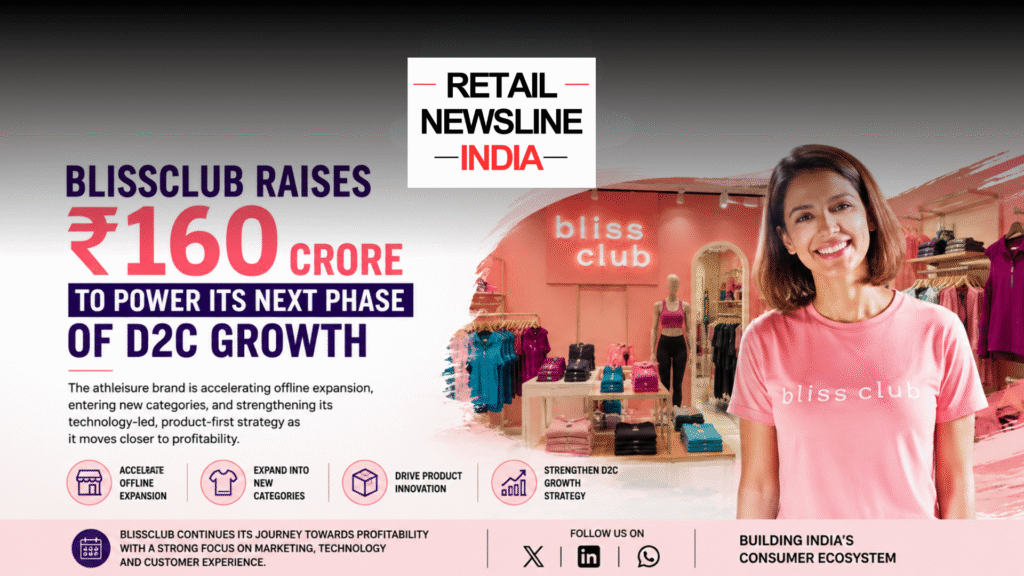
Bengaluru-based athleisure brand BlissClub has raised ₹160 crore in fresh funding, marking a significant step in its plans to scale offline retail, expand its product portfolio, strengthen product innovation and deepen its direct-to-consumer (D2C) ecosystem.
The funding round was led by Singularity AMC, with existing investors Elevation Capital and Eight Roads Ventures also participating. BlissClub founder Minu Margaret and her husband, Meesho co-founder Vidit Aatrey, additionally invested personal capital alongside institutional investors.
The latest fundraise comes as BlissClub looks to evolve from a women-focused activewear company into a broader Indian athleisure and lifestyle brand with an increasingly omnichannel business model.
BlissClub Funding: ₹160 Crore to Power the Next Growth Phase
The new ₹160 crore investment gives BlissClub additional capital to pursue several growth priorities, including offline retail expansion, new product categories, product development and technology investments.
For a D2C fashion brand, the strategy is particularly notable because BlissClub is not abandoning its digital-first model while expanding offline. Instead, the company is attempting to build an omnichannel engine in which its own website, mobile app, marketplaces and physical stores work together.
BlissClub previously raised ₹33 crore in a 2025 round led by Elevation Capital, with participation from Eight Roads Ventures. The company had also raised $15 million in 2022 in a round led by the same investors.
From Women’s Activewear to a Broader Athleisure Brand
Founded in 2020, BlissClub initially focused on designing activewear specifically for women. Its proposition centred on comfort, functionality, fit and apparel designed around the movement patterns and needs of Indian consumers.
The company has gradually expanded beyond its original category. Earlier in 2026, BlissClub entered menswear, while denim has emerged as another major product opportunity for the brand.
The denim category is particularly important because it represents a move beyond conventional performance wear and into everyday lifestyle apparel. After years of product development, the category could help BlissClub increase its addressable market and encourage existing customers to purchase from the brand across more occasions.
This broader product strategy reflects a larger shift among Indian D2C brands: instead of remaining confined to a single hero category, successful companies are increasingly attempting to build multi-category lifestyle brands around an established customer base.
D2C Remains at the Core of BlissClub’s Business
Despite its offline expansion plans, digital commerce remains central to BlissClub’s growth strategy.
According to the company’s reported channel mix, approximately 80–85% of revenue comes from online channels, with the majority of online sales generated through BlissClub’s own website and mobile application. Marketplaces account for the remainder of online sales, while offline retail contributes roughly 15% of total revenue.
This makes the company’s D2C technology infrastructure an important investment area.
Rather than viewing physical stores as a replacement for online commerce, BlissClub appears to be pursuing an omnichannel retail strategy in which stores can improve brand discovery, customer experience and accessibility while the D2C platform continues to drive repeat purchases and customer relationships.
Why Offline Retail Matters for BlissClub
The move into physical retail comes at a time when several Indian D2C brands are expanding beyond their original online-first models.
For apparel and athleisure businesses, offline stores offer advantages that are difficult to replicate digitally. Customers can physically experience fabrics, assess fit, compare sizes and understand product construction before purchasing.
BlissClub has already been building its physical footprint. In 2025, the company opened its 16th store at Elan Epic Mall in Gurugram, highlighting its strategy of using physical locations to strengthen consumer access and brand presence.
The next phase is expected to focus on strengthening BlissClub’s presence in established markets rather than pursuing indiscriminate national expansion.
The company is targeting key metro and Tier I markets including Bengaluru, Delhi, Mumbai, Hyderabad and Pune.
This measured approach could help BlissClub improve store productivity while keeping the capital requirements of offline expansion under control.
Product Innovation as a Competitive Advantage
One of the defining elements of BlissClub’s strategy is its emphasis on product innovation.
The brand has invested in developing proprietary fabrics and works directly with manufacturing mills. This approach gives the company greater influence over fabric quality, product development, manufacturing economics and differentiation.
In a crowded Indian activewear market, this product-first strategy could become increasingly important.
Athleisure consumers are no longer choosing products purely on brand recognition. Factors such as fabric technology, comfort, fit, durability, performance and versatility increasingly influence purchasing decisions.
For BlissClub, developing differentiated products can also support customer retention. If consumers associate the brand with a particular level of comfort and fit, the company can potentially create stronger repeat-purchase behaviour across new categories.
BlissClub Revenue and Path to Profitability
BlissClub’s latest expansion strategy comes against a backdrop of strong revenue growth.
The company reportedly generated ₹135 crore in FY25 revenue, compared with ₹92 crore in FY24, while also significantly reducing its losses from the previous year. Earlier reports in 2026 indicated that BlissClub had crossed a ₹250 crore annualised revenue run rate, demonstrating the acceleration in its business scale.
The company is targeting approximately ₹200 crore in net revenue for FY26 while aiming to bring losses down to the low-single-digit range.
The focus on reducing losses is important. The latest capital infusion is therefore not simply about increasing sales; it is also about building a more efficient business capable of approaching breakeven while continuing to invest in growth.
An earlier industry research report also described BlissClub as a D2C-first activewear business with an expanding omnichannel presence, highlighting its investment in product R&D and offline experiences.
What the ₹160 Crore Funding Means for BlissClub
The latest fundraise could have implications across four major areas:
1. Faster Offline Expansion
Capital will allow BlissClub to increase its store footprint in priority markets and improve physical access to its products.
2. More Product Categories
Menswear and denim provide the company with opportunities to expand its total addressable market beyond women’s activewear.
3. Stronger D2C Technology
Investment in technology can help BlissClub improve customer acquisition, retention, personalisation, inventory management and the overall online shopping experience.
4. Better Path to Profitability
With FY26 revenue expected to reach around ₹200 crore and losses targeted at low single digits, the company is increasingly focused on balancing growth with financial discipline.
BlissClub’s Position in India’s Growing Athleisure Market
India’s athleisure market has become increasingly competitive, with established sportswear companies, fashion retailers and digitally native startups all competing for consumers.
BlissClub’s differentiation lies in its combination of D2C distribution, proprietary product development, community-led branding and an expanding offline footprint.
Its challenge will be to maintain this differentiation as it enters additional categories.
Moving from women’s activewear into menswear, denim and broader lifestyle apparel creates a much larger opportunity, but it also places the company in competition with a wider range of fashion and apparel brands.
The ability to maintain product quality and brand identity while scaling distribution will therefore be critical.
The Road Ahead for BlissClub
The ₹160 crore fundraise represents a new phase for BlissClub.
The company is moving from a predominantly digital women’s activewear business toward a broader omnichannel athleisure and lifestyle platform. Its strategy combines offline expansion with continued investment in D2C technology and product innovation.
The immediate priorities are clear: build more stores in high-potential markets, launch new categories, strengthen its proprietary product capabilities and move closer to profitability.
If BlissClub can execute this strategy while maintaining strong customer retention and disciplined store economics, the company could strengthen its position among India’s leading homegrown D2C athleisure brands.
The latest investment from Singularity AMC, alongside continued backing from Elevation Capital and Eight Roads Ventures, signals investor confidence in that next stage of growth.
FAQs About BlissClub’s ₹160 Crore Funding
1. How much funding has BlissClub raised in 2026?
BlissClub has raised ₹160 crore in its latest funding round, led by Singularity AMC, with participation from existing investors Elevation Capital and Eight Roads Ventures.
2. Who founded BlissClub?
BlissClub was founded in 2020 by Minu Margaret. The Bengaluru-based company started as a women’s activewear brand and has since expanded into broader athleisure and lifestyle categories.
3. Who invested in BlissClub’s latest funding round?
The latest round was led by Singularity AMC. Existing investors Elevation Capital and Eight Roads Ventures also participated. Founder Minu Margaret and her husband, Meesho co-founder Vidit Aatrey, invested personal capital alongside institutional investors.
4. How will BlissClub use the ₹160 crore funding?
The capital is expected to support offline retail expansion, new product categories, product innovation and technology investments for its D2C business.
5. Is BlissClub expanding beyond women’s activewear?
Yes. BlissClub has expanded into menswear and is also preparing to enter the denim category, reflecting its broader ambition to become an athleisure and lifestyle brand.
6. What is BlissClub’s D2C strategy?
BlissClub remains strongly digital-first. A large majority of its online sales reportedly come through its own website and mobile application, while marketplaces and physical stores provide additional distribution channels.
7. Where is BlissClub expanding its offline presence?
The company plans to strengthen its presence in key metro and Tier I markets, including Bengaluru, Delhi, Mumbai, Hyderabad and Pune, with a measured approach to store expansion.
8. What is BlissClub’s FY26 revenue target?
BlissClub expects to close FY26 with approximately ₹200 crore in net revenue, while aiming to reduce losses to the low-single-digit range and move closer to breakeven.
9. What makes BlissClub different from other activewear brands?
BlissClub places significant emphasis on product development, proprietary fabrics, comfort, fit and direct engagement with manufacturing mills, alongside a community-oriented D2C model and growing offline presence.
10. Why is BlissClub’s ₹160 crore fundraise significant?
The funding gives BlissClub the resources to pursue its next stage of growth across D2C, offline retail, product innovation and category expansion. It also reflects continued investor confidence in India’s growing athleisure and digitally native consumer market.