
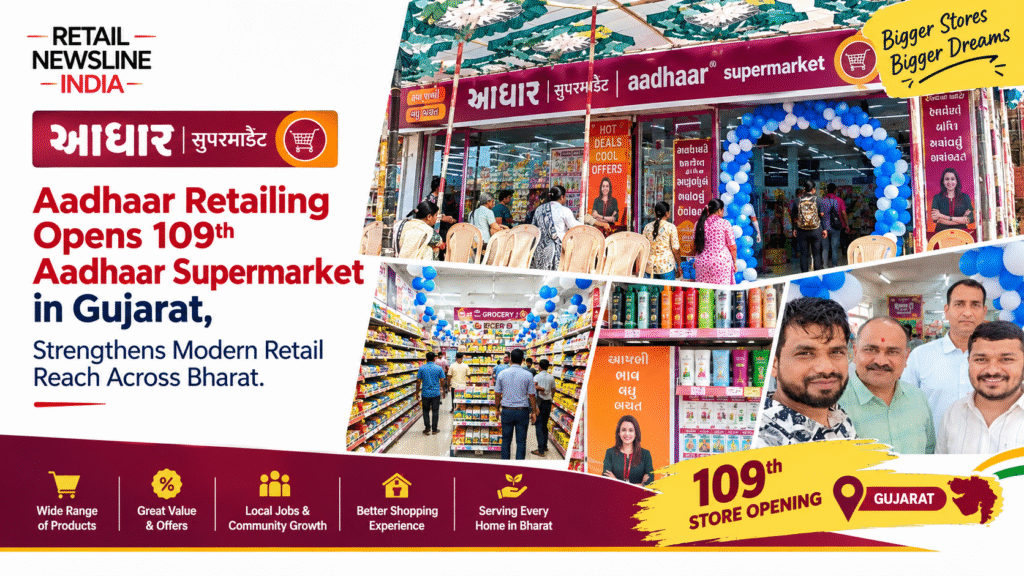
Aadhaar Retailing Limited has reached a new retail milestone with the opening of its 109th Aadhaar Supermarket in Gujarat, strengthening the company’s modern retail presence and taking its supermarket network deeper into India’s regional and semi-urban markets.
The latest store opening marks another step in Aadhaar Retailing’s stated mission of bringing modern retail closer to Bharat, with a focus on product variety, value, convenience and stronger connections with local communities.
For Aadhaar Retailing, every new store represents more than an increase in its physical footprint. The company’s expansion strategy is centred on making organised retail more accessible to consumers beyond India’s largest metropolitan markets.
Aadhaar Supermarket Reaches 109 Stores
The latest Gujarat opening takes Aadhaar Retailing’s reported supermarket network to 109 stores.
The milestone follows a series of store openings across different parts of India, including Punjab, Haryana, Gujarat, Rajasthan and Karnataka.
Recent expansion activity has included stores in markets such as Sunam, Chhabal, Assandh and Goraya, demonstrating the company’s continued focus on regional and emerging retail markets.
The progression to 109 stores comes after Aadhaar Supermarket previously celebrated reaching the 100-store milestone.
Aadhaar’s 100-Store Milestone
Aadhaar Supermarket previously reached 100 stores with an opening in Bhiloda, Gujarat.
The milestone was positioned by the company as an important stage in its journey of bringing quality products, value and convenience closer to consumers.
The subsequent expansion from 100 to 109 stores demonstrates the retailer’s continued investment in physical retail infrastructure.
For a supermarket business focused on everyday consumption, store density and geographic accessibility remain important parts of the customer proposition.
Bringing Modern Retail Closer to Bharat
Aadhaar Retailing’s business positioning is strongly connected to rural and semi-urban India.
The company operates a modern retail format designed to provide consumers outside major metropolitan markets with access to a broad selection of everyday products.
Its retail proposition focuses on:
- Product variety
- Competitive value
- Convenient shopping
- Everyday essentials
- FMCG products
- Household products
- Personal-care products
- Local community engagement
This approach allows Aadhaar to position its stores as one-stop destinations for regular household shopping.
Aadhaar Supermarket’s Product Categories
Aadhaar Supermarket operates primarily in grocery, FMCG and general retail.
Its assortment includes categories such as:
- Grocery and food products
- FMCG products
- Household essentials
- Personal-care products
- Home-care products
- Fresh products
- Daily-use consumer goods
- General merchandise
The broad assortment is intended to provide customers with multiple everyday shopping requirements under one roof.
For consumers in smaller towns and semi-urban markets, this format can provide an alternative to fragmented shopping across multiple individual stores.
Aadhaar Retailing’s Multi-State Expansion
Aadhaar Retailing has developed a presence across multiple Indian states.
Its current retail footprint includes:
Punjab: One of the company’s important markets, with recent store additions in locations including Sunam, Chhabal and Goraya.
Gujarat: A significant market for Aadhaar, including its 100-store milestone in Bhiloda and subsequent expansion.
Haryana: The company has continued adding stores in the state, including the 107th-store milestone in Assandh.
Rajasthan: Rajasthan is also part of Aadhaar’s broader regional expansion strategy.
Karnataka: The company has expanded into southern India as part of its multi-state growth strategy.
This geographical diversification allows Aadhaar to build a network across different consumer markets rather than relying solely on metropolitan locations.
Recent Aadhaar Supermarket Store Expansion
Aadhaar’s recent openings illustrate the pace and geographical spread of its expansion.
The company opened a new store in Sunam, Punjab, highlighting its focus on quality products, value and modern shopping experiences.
It subsequently expanded further in Punjab with a store in Chhabal, Tarn Taran district.
The company then announced its 107th store in Assandh, Haryana, followed by its 108th store in Goraya, Punjab.
The latest Gujarat launch has taken the reported network to 109 stores.
This sequence demonstrates the retailer’s continued focus on adding stores across regional markets.
Aadhaar’s 2026 Expansion Target
Aadhaar Retailing has also outlined an ambitious expansion target for 2026.
The company had communicated a goal of reaching 117 stores before Diwali 2026.
The planned network was distributed across five states:
| State | Planned Stores |
| Punjab | 55 |
| Haryana | 20 |
| Gujarat | 22 |
| Karnataka | 5 |
| Rajasthan | 15 |
| Total | 117 |
The 117-store figure represents an expansion target rather than a completed store count.
With the company now reporting 109 stores, the milestone places Aadhaar closer to that previously stated objective.
Why Rural and Semi-Urban Retail Matters
India’s retail landscape is changing as organised retail expands beyond the largest cities.
Historically, modern supermarket chains have concentrated heavily on metropolitan and large urban markets.
However, increasing consumer aspirations, improved connectivity, changing shopping habits and greater availability of branded FMCG products are creating opportunities in smaller cities and towns.
Aadhaar’s business model is built around this opportunity.
Its focus on rural and semi-urban consumers means that store expansion is not simply about entering smaller cities. It is about building a retail format specifically designed around local household consumption and everyday shopping requirements.
Aadhaar’s Community-Centric Retail Approach
Aadhaar’s latest store communication places strong emphasis on the local community.
The company describes its stores as a way of providing:
Better product choice
Greater value
Improved shopping experience
Stronger local community connect
This positioning is particularly relevant in smaller towns, where retail stores can become important shopping destinations within the local community.
The company also acknowledges the role of customers, landlords, vendor partners, brand partners and employees in supporting its expansion.
Strong FMCG Ecosystem
A supermarket’s success depends heavily on its ability to offer a broad and reliable product assortment.
Aadhaar’s store communications have highlighted relationships with several major FMCG and consumer brands, including:
- Hindustan Unilever
- ITC
- Procter & Gamble
- Nestlé
- PepsiCo
- Coca-Cola
- Marico
- Dabur
- Tata Consumer
- Britannia
- Parle
- Godrej Consumer Products
- Colgate-Palmolive
- Reckitt
- Mondelez
- Amul
- Emami
- Jyothy Labs
- Nirma
- Patanjali
- Reliance Consumer Products
These relationships contribute to the product variety available across the retailer’s supermarket network.
From Bharat, For Bharat
Aadhaar Retailing’s phrase “From Bharat, For Bharat” captures the central theme of its current expansion narrative.
The company’s growth is focused on bringing organised retail closer to consumers in markets that have historically had less access to large-format modern retail.
The 109th store therefore represents more than another number in the company’s expansion journey.
It reflects the retailer’s continuing effort to create a geographically distributed supermarket network across India’s regional markets.
Aadhaar Supermarket 109th Store: Key Details
| Detail | Information |
| Company | Aadhaar Retailing Limited |
| Retail Brand | Aadhaar Supermarket |
| Milestone | 109th store |
| State | Gujarat |
| Retail Segment | Grocery, FMCG and modern retail |
| Core Markets | Rural and semi-urban India |
| Reported State Footprint | Punjab, Gujarat, Rajasthan and Karnataka, with expansion in Haryana |
| Expansion Strategy | Regional and emerging markets |
| Previous Milestone | 100 stores |
| Earlier 2026 Target | 117 stores before Diwali |
| Positioning | Modern retail closer to Bharat |
Conclusion
Aadhaar Retailing’s 109th Aadhaar Supermarket marks another milestone in the company’s expansion of modern retail across Bharat.
From reaching its first 100-store milestone to expanding toward 109 outlets, Aadhaar continues to build a physical retail network focused on value, product choice, convenience and community connection.
Its expansion across Punjab, Gujarat, Haryana, Rajasthan and Karnataka demonstrates a strategy that goes beyond India’s largest metropolitan markets.
As organised retail continues to penetrate smaller cities and towns, Aadhaar Retailing’s growth reflects the increasing importance of regional and semi-urban India in the country’s modern retail landscape.
109 stores. A growing retail network. From Bharat, For Bharat.
Frequently Asked Questions
How many Aadhaar Supermarket stores are there in India?
Aadhaar Retailing has announced reaching the 109-store milestone with its latest Gujarat expansion.
What is Aadhaar Supermarket?
Aadhaar Supermarket is the modern retail format operated by Aadhaar Retailing Limited, with a focus on grocery, FMCG, household and everyday consumer products.
Where does Aadhaar Supermarket operate?
Aadhaar Retailing has established its presence across markets including Punjab, Gujarat, Haryana, Rajasthan and Karnataka.
What products does Aadhaar Supermarket sell?
Aadhaar Supermarket offers grocery, FMCG, household, personal-care, home-care, fresh and general merchandise products.
What is Aadhaar Retailing’s expansion strategy?
Aadhaar focuses strongly on rural, semi-urban and regional markets, aiming to bring organised modern retail closer to consumers outside India’s largest metropolitan cities.
What was Aadhaar Retailing’s 2026 store target?
The company had previously outlined a target of reaching 117 stores before Diwali 2026, covering Punjab, Haryana, Gujarat, Karnataka and Rajasthan.
What does “From Bharat, For Bharat” mean for Aadhaar?
The phrase represents Aadhaar’s focus on building a modern retail network that serves consumers across India’s regional, rural and semi-urban markets.