
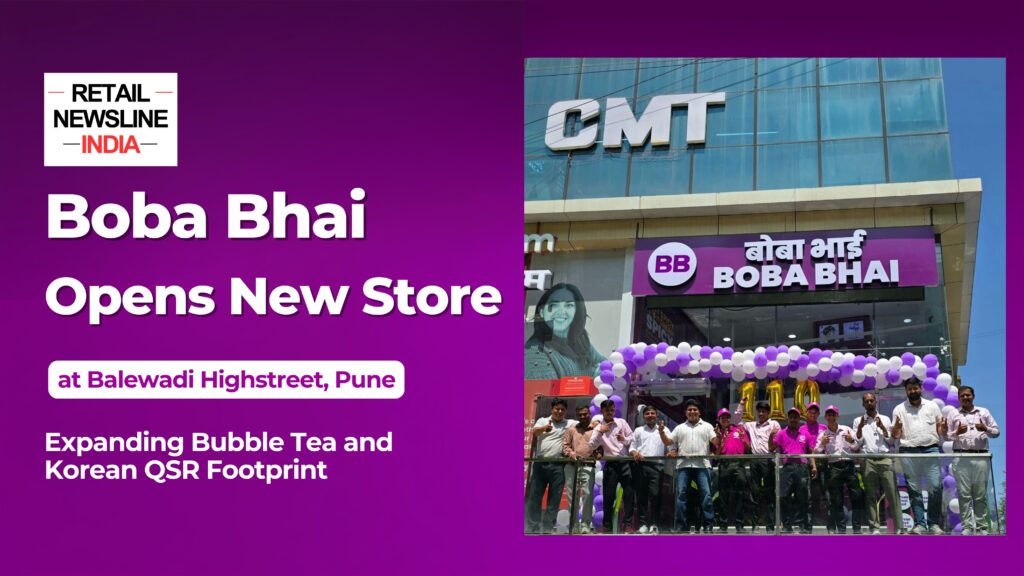
Bubble tea and Korean-inspired quick-service restaurant brand Boba Bhai has expanded its presence in Pune with a new store at Balewadi Highstreet.
The latest opening adds another physical touchpoint for the fast-growing food and beverage brand as it continues to scale its network across India’s urban markets.
The Balewadi location is particularly relevant to Boba Bhai’s growth strategy because Pune has emerged as an important market for younger consumers, professionals, students and experience-led food formats.
The new store also comes at an important stage in Boba Bhai’s growth journey. The brand crossed the 100-store milestone in June 2026, marking a significant acceleration only around two and a half years after its launch.
Boba Bhai’s Rapid Retail Expansion
Boba Bhai was founded in 2023 and has built its identity around bubble tea, Korean-inspired street food and youth-oriented QSR experiences.
The company reached its 100th store at Whiteland Urban Cubes 71 in Sector 71, Gurugram, on June 1, 2026.
That outlet became the brand’s 28th store in Delhi-NCR and eighth in Gurugram, underlining the importance of deeper penetration in established markets alongside expansion into newer cities.
Founder Dhruv Kohli described the 100-store achievement as a major milestone in the company’s journey, noting that the brand had reached the mark in approximately 2.5 years.
The Balewadi Highstreet opening therefore comes as Boba Bhai enters its next stage of national expansion.
What Makes Boba Bhai Different?
Boba Bhai’s positioning combines two major consumer trends:
Bubble tea + Korean-inspired food
The brand initially built its consumer proposition around bubble tea before expanding into Korean-inspired food categories.
According to Indian Retailer, Boba Bhai expanded into Korean-inspired food in 2025, helping create a more diversified food-and-beverage proposition.
Its menu has evolved beyond beverages to include products such as:
- Bubble tea
- Korean-inspired beverages
- Korean fried chicken
- Korean-style burgers
- Corndogs
- Ramen
- Momos
- Loaded fries
- Fusion snacks
- Other Korean-Indian fusion offerings
This combination gives the brand a broader consumption occasion than a beverage-only bubble tea chain.
Bubble Tea Meets Korean Street Food
Boba Bhai’s core differentiation comes from adapting international food trends to Indian consumer preferences.
The company describes its concept around Korean-inspired food made for Indian consumers, while its beverage portfolio draws inspiration from Korean, Taiwanese and Japanese flavours.
This approach allows Boba Bhai to participate in several growing categories simultaneously:
Bubble tea: A visually distinctive and highly shareable beverage category.
Korean food: A cuisine gaining visibility among younger Indian consumers.
QSR: A convenient format suitable for malls, high streets and delivery-led consumption.
Fusion food: A way to adapt international flavours to local preferences.
The Balewadi Highstreet store brings this proposition into another important Pune catchment.
Boba Bhai’s FY26 Revenue Reaches Nearly ₹70 Crore
Boba Bhai’s store expansion is supported by substantial top-line growth.
The company reported net revenue of approximately ₹70 crore in FY26, compared with ₹28 crore in FY25.
That represents a 145% year-on-year increase in net revenue.
The revenue mix also indicates that Boba Bhai is becoming more than a bubble tea business.
According to Indian Retailer, the company’s food and beverage businesses were contributing roughly equally to overall revenue after its expansion into Korean-inspired food.
This diversification is strategically important because food provides an additional reason for customers to visit Boba Bhai outlets.
Food and Beverages Build a Balanced Revenue Model
The evolution of Boba Bhai’s menu has changed the role of its stores.
Initially, bubble tea was central to the brand’s identity.
The introduction of Korean-inspired food has created opportunities to increase:
- Average order value
- Meal occasions
- Customer frequency
- Group consumption
- Delivery orders
- Afternoon and evening visits
The combination of food and beverages also gives Boba Bhai more flexibility when choosing store locations.
Instead of functioning purely as a beverage destination, the brand can compete within the broader QSR and casual-food ecosystem.
From 90+ Stores to 100 Stores
Boba Bhai’s growth trajectory has been exceptionally fast.
In the first half of 2026, the brand was already discussing its expansion from a 90+ store network toward the 100-store milestone.
The company subsequently opened its 100th store in Gurugram on June 1.
The milestone is notable because Boba Bhai reached 100 stores in roughly 2.5 years, according to its founder.
This places speed of store rollout at the centre of the company’s growth strategy.
The Balewadi Highstreet store is part of that broader expansion momentum.
Boba Bhai Targets 200–250% Revenue Growth in FY27
The company’s ambitions extend well beyond reaching 100 stores.
Founder Dhruv Kohli has indicated that Boba Bhai is targeting 200–250% revenue growth in FY27.
The target reflects management’s confidence in the demand for bubble tea, Korean food and digitally discoverable QSR brands.
Indian Retailer reported that the company intends to deepen its presence in its existing eight-city network before entering additional markets such as Kolkata and Ahmedabad.
This approach suggests that Boba Bhai is looking at both:
Depth: More stores in markets where the brand already has recognition.
Breadth: Expansion into new cities once existing clusters become stronger.
Is Boba Bhai Targeting 250–300 Stores?
Reports around the company’s FY27 plans have indicated an ambition to reach approximately 250–300 stores, alongside revenue of more than ₹200 crore.
The company’s broader growth plans therefore involve substantial network expansion rather than simply maintaining the existing 100-store footprint.
The strategic focus is on creating a scalable operating platform that can support a much larger store base.
Building Infrastructure Behind the Store Network
Rapid QSR expansion requires more than opening outlets.
Food preparation, ingredient sourcing, supply-chain management, quality control and consistency become increasingly important as the network grows.
Boba Bhai has been investing in backend infrastructure to support its expansion.
The company has also been working on an automated manufacturing facility in Bengaluru intended to support a significantly larger outlet network.
This kind of infrastructure becomes increasingly important when a QSR brand moves from tens of outlets to hundreds.
The objective is to create greater consistency while allowing individual stores to operate efficiently.
Why Balewadi Is Important for Boba Bhai
Balewadi has developed into one of Pune’s prominent commercial and lifestyle areas.
Its combination of residential development, offices, retail destinations, food outlets and younger consumers makes it relevant for experience-led QSR concepts.
For Boba Bhai, Balewadi offers several attractive consumer segments:
- Young professionals
- College students
- Families
- Food enthusiasts
- Gen Z consumers
- Social-media-driven consumers
- Consumers interested in Asian flavours
The area’s high-street environment also fits a brand that relies heavily on visibility, discovery and impulse consumption.
Pune’s QSR Opportunity
Pune has become an important market for India’s organised food and beverage sector.
The city’s large student population, technology workforce, growing residential catchments and evolving lifestyle culture have created demand for new food formats.
For QSR brands, Pune provides an opportunity to test concepts that combine:
Affordability + Convenience + Experience + Social Discovery
Boba Bhai’s proposition fits particularly well into this environment.
Its colourful beverages, Korean-inspired food and youth-oriented positioning can also translate effectively into social media content and word-of-mouth marketing.
Boba Bhai and the Gen Z Consumer
Boba Bhai has positioned itself strongly around younger consumers.
This is important because Gen Z food consumption is increasingly influenced by factors beyond taste and price.
Consumers also respond to:
- Presentation
- Novelty
- Global food trends
- Social-media visibility
- Brand personality
- Store experience
- Convenience
- Delivery availability
Bubble tea naturally fits this environment because it is highly visual and customisable.
Korean-inspired food adds another layer of cultural relevance.
Together, they create a format designed around discovery and experience rather than only functional dining.
The Rise of Korean Food in India
Korean culture has gained significant visibility among Indian consumers through entertainment, music, beauty and food.
Korean cuisine has consequently moved beyond specialist restaurants into mainstream food discovery.
Boba Bhai’s strategy takes advantage of this trend by presenting Korean-inspired food in a more accessible QSR format.
Rather than positioning itself as a traditional Korean restaurant, the brand adapts Korean flavours into burgers, fried chicken, snacks, noodles and other formats that are familiar to Indian consumers.
This makes the proposition easier to scale through standardised QSR outlets.
Bubble Tea Is Becoming a Larger Indian F&B Category
Bubble tea was once considered a niche beverage category in India.
However, the growth of youth-focused food brands and international beverage concepts has increased consumer awareness.
Boba Bhai’s own growth demonstrates the opportunity.
The company’s FY26 net revenue rose from ₹28 crore to approximately ₹70 crore, while the brand expanded its store network rapidly.
This suggests that bubble tea can function as more than a novelty product when combined with the right brand, pricing, location strategy and food proposition.
From Beverage Brand to Full QSR Platform
One of the most important developments in Boba Bhai’s journey is its transition from a bubble tea-focused concept into a broader QSR platform.
The business now operates across multiple consumption occasions.
Beverage occasion: Bubble tea and specialty drinks.
Snack occasion: Fries, momos, corndogs and other quick bites.
Meal occasion: Korean-inspired burgers, fried chicken, ramen and other food offerings.
Delivery occasion: Food and beverages through digital ordering channels.
This broader portfolio can help increase the productivity of individual stores.
Digital Distribution and Quick Commerce
Boba Bhai is also pursuing an omnichannel approach.
Indian Retailer reported that the company is expanding its digital distribution and quick-commerce strategy, aligning with convenience-led consumption among younger customers.
This creates a model where physical stores and digital channels reinforce one another.
Stores provide:
- Brand visibility
- Product experience
- Customer acquisition
- Delivery infrastructure
- Local market presence
Digital platforms provide:
- Convenience
- Repeat ordering
- Wider discovery
- Quick-commerce availability
- Data-driven customer engagement
The combination can potentially increase the productivity of each retail location.
Boba Bhai’s 10-Store-in-10-Days Expansion Momentum
The company’s expansion pace has continued into 2026.
A LinkedIn post from Boba Bhai leadership highlighted that the brand had opened 10 new stores across India in a 10-day period, spanning markets including Mumbai, Delhi and Pune.
That pace illustrates the operational intensity behind the company’s national rollout.
For a QSR brand, opening multiple stores within a short period requires coordination across:
- Real estate
- Leasing
- Design
- Construction
- Equipment
- Hiring
- Training
- Supply chain
- Marketing
- Technology
- Store operations
The Balewadi Highstreet opening can therefore be viewed within this wider network-building exercise.
The Role of Retail Leasing in QSR Expansion
Boba Bhai’s expansion also highlights the growing importance of organised retail leasing in the food and beverage sector.
CYK Hospitalities has worked on strategic expansion and leasing mandates involving Boba Bhai and several other F&B brands across high-street and commercial destinations.
For QSR brands, choosing the right location can have a direct impact on:
- Walk-in traffic
- Delivery radius
- Brand visibility
- Store economics
- Customer demographics
- Repeat visits
Balewadi Highstreet provides Boba Bhai with a location aligned with the brand’s target audience.
Boba Bhai’s Store Expansion Strategy
The company’s expansion model appears to combine multiple formats and locations.
Its strategy includes:
Metro penetration: Strengthening existing markets.
Tier-II expansion: Entering emerging urban consumption centres.
Cluster strategy: Building multiple stores in markets where the brand already has recognition.
Digital distribution: Using online and quick-commerce channels to expand customer access.
Menu diversification: Combining beverages and food.
Infrastructure investment: Building backend capabilities to support hundreds of stores.
This multi-layered approach can help reduce dependence on a single product category or sales channel.
What the Balewadi Store Means for Pune
The new Balewadi Highstreet outlet gives Boba Bhai another opportunity to build local brand recognition in Pune.
For consumers, the store adds another destination for bubble tea and Korean-inspired QSR food.
For the company, it provides another physical unit within a high-potential urban market.
The store also contributes to the broader objective of increasing Boba Bhai’s density across India rather than relying solely on new-city launches.
Boba Bhai’s Growth Challenge
Rapid expansion creates significant opportunities, but it also introduces operational challenges.
A 100-store network requires a different operating structure compared with a 20- or 30-store business.
The company must maintain:
- Product consistency
- Food safety
- Service quality
- Supply-chain reliability
- Employee training
- Store-level profitability
- Customer experience
- Brand consistency
The expansion of backend infrastructure will therefore be as important as the expansion of the physical store network.
Profitability Will Become Increasingly Important
Boba Bhai’s revenue growth has been strong, but the company has also reported increased losses.
According to Inc42, the company’s net loss widened to approximately ₹12.5 crore in FY26 from ₹9.5 crore in FY25, even as revenue increased sharply.
This creates an important next-stage challenge.
The company has demonstrated that consumers are willing to engage with the concept.
The next question is whether the brand can translate rapid store and revenue growth into improving unit economics and eventual profitability.
The Bigger Indian QSR Opportunity
Boba Bhai’s growth reflects a larger change in India’s food retail market.
Indian consumers are increasingly experimenting with:
- Asian cuisine
- Korean food
- Bubble tea
- Japanese-inspired beverages
- Fusion food
- Premium snacks
- Experience-led QSRs
At the same time, digital discovery through social media and food-delivery platforms has reduced the barriers for new brands to build awareness.
This environment creates opportunities for brands that can turn global food trends into scalable Indian formats.
What’s Next for Boba Bhai?
The next phase of Boba Bhai’s journey is likely to focus on three major areas.
1. Increasing Store Density
The brand is expected to continue adding stores in existing markets to improve customer reach and operating leverage.
2. Entering New Cities
Markets such as Kolkata and Ahmedabad have been identified as potential expansion destinations as the company grows beyond its existing city network.
3. Scaling Food and Beverage Categories
Boba Bhai is expected to continue expanding its menu beyond traditional bubble tea, strengthening its positioning as a complete Korean-inspired QSR platform.
Conclusion
The opening of Boba Bhai’s new store at Balewadi Highstreet, Pune comes at a defining moment for the rapidly growing QSR brand.
Founded in 2023, Boba Bhai has already crossed 100 stores, with its 100th outlet opening in Gurugram in June 2026.
The company also reported ₹70 crore in FY26 net revenue, representing a 145% increase from ₹28 crore in FY25.
Its ambitions for FY27 are significantly larger, with management targeting 200–250% revenue growth, while the brand continues to expand its physical network and digital distribution capabilities.
The Balewadi Highstreet store is therefore more than a new Pune outlet. It represents another step in Boba Bhai’s transformation from a young bubble tea startup into a nationwide Korean-inspired QSR and food-and-beverage platform.
As Indian consumers increasingly embrace global flavours, experiential food formats and youth-oriented brands, Boba Bhai’s combination of bubble tea, Korean-inspired food, digital convenience and rapid physical expansion positions it as an interesting player to watch in India’s evolving QSR market.
Frequently Asked Questions
1. Where has Boba Bhai opened its new Pune store?
Boba Bhai has opened a new store at Balewadi Highstreet in Pune, expanding its presence in the city’s growing QSR and lifestyle-food market.
2. What does Boba Bhai sell?
Boba Bhai sells bubble tea and Korean-inspired food, including beverages, burgers, Korean-style fried chicken, corndogs, ramen, momos, loaded fries and other fusion offerings.
3. When did Boba Bhai cross 100 stores?
Boba Bhai crossed the 100-store milestone in June 2026, opening its 100th outlet at Whiteland Urban Cubes 71 in Sector 71, Gurugram.
4. When was Boba Bhai founded?
Boba Bhai was founded in 2023 and reached 100 stores approximately two and a half years later.
5. What was Boba Bhai’s FY26 revenue?
Boba Bhai reported approximately ₹70 crore in net revenue in FY26, compared with ₹28 crore in FY25, representing 145% year-on-year growth.
6. What is Boba Bhai’s FY27 revenue growth target?
The company is targeting approximately 200–250% revenue growth in FY27, according to reports citing founder Dhruv Kohli.
7. How many Boba Bhai stores are there?
Boba Bhai crossed 100 stores in June 2026 with the opening of its Gurugram outlet.
8. Why is Boba Bhai expanding rapidly?
Boba Bhai is benefiting from growing consumer interest in bubble tea, Korean-inspired food, experiential QSR formats and youth-focused food brands. Its strategy combines physical stores with digital and quick-commerce distribution.
9. Is Boba Bhai expanding beyond major metro cities?
Yes. The company has indicated that its growth strategy includes deeper penetration into existing metro markets while accelerating expansion into emerging Tier-II markets.
10. Which cities could Boba Bhai enter next?
Indian Retailer has reported that Boba Bhai is considering markets including Kolkata and Ahmedabad as part of its future expansion.
11. Is Boba Bhai only a bubble tea company?
No. Boba Bhai has expanded significantly into Korean-inspired food, with food and beverage categories each contributing roughly half of the company’s revenue according to FY26 reporting.
12. What makes Boba Bhai different from traditional QSR brands?
Boba Bhai combines bubble tea, Korean-inspired food, Indian fusion and a Gen Z-focused brand experience, creating a hybrid beverage-and-food QSR proposition.