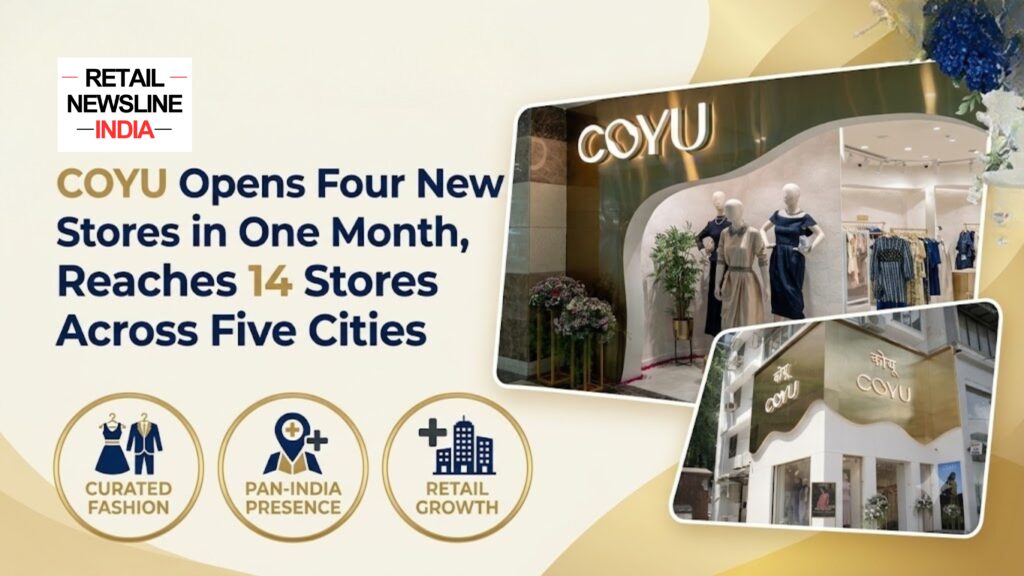
Coyu, the multi-brand fashion retail platform, has accelerated its offline expansion with the opening of four new stores in a single month across Gurugram, Ahmedabad and Mumbai. The latest openings take Coyu’s retail footprint to 14 stores across five cities, with the platform now hosting 350+ brands.
The new stores are located at DLF Summit, Gurugram; Ambience Mall, Gurugram; Sindhu Bhavan, Ahmedabad; and Linking Road, Mumbai. Coyu’s official store network confirms its presence at DLF Summit, Ambience Mall Gurugram and Sindhu Bhavan, while the brand’s recent expansion communication highlights the new Linking Road location in Mumbai.
The rapid expansion highlights the growing role of experiential, multi-brand fashion retail in India, particularly as consumers look for physical spaces where they can discover emerging homegrown labels alongside established and international brands.
Coyu Adds Four Stores Across Key Retail Locations
Coyu’s latest expansion covers three major fashion markets:
- DLF Summit, Gurugram
- Ambience Mall, Gurugram
- Sindhu Bhavan, Ahmedabad
- Linking Road, Mumbai
The locations give Coyu access to established retail catchments across the Delhi-NCR, Gujarat and Mumbai markets.
The company’s official store page lists the DLF Summit and Ambience Mall Gurugram locations, along with its Sindhu Bhavan store in Ahmedabad.
The new Mumbai store marks another important step for the brand. Coyu recently described the Linking Road outlet as its second Mumbai store, strengthening its presence in one of the city’s most recognised fashion and high-street retail destinations.
From One Store to 14 Stores in 20 Months
One of the most significant numbers behind Coyu’s expansion is the speed at which the company has scaled.
According to the company’s latest expansion announcement, Coyu had one store 20 months ago. It now operates 14 stores across five cities, representing a rapid expansion of its physical retail network.
The platform also says its stores collectively offer access to more than 350 brands.
This growth positions Coyu differently from a conventional single-brand fashion retailer.
Instead of building its proposition around one label, Coyu is creating a multi-brand discovery platform, bringing together India’s homegrown fashion brands and global labels under one retail experience.
Building a Multi-Brand Fashion Destination
Coyu describes itself as a curated shopping destination where customers can discover fashion brands in a physical environment.
Its online platform currently features categories spanning dresses, co-ord sets, kurta sets, tops, shirts, kaftans, sarees, bottomwear, jewellery, bags and footwear.
The physical-store proposition adds another dimension.
Customers can see products in person, explore different labels within one destination and receive assistance from fashion specialists.
The brand’s retail proposition has also been described as incorporating services such as personal shoppers, fashion stylists, try-at-home services and rapid delivery, positioning the stores as more than conventional retail outlets.
Why Coyu Is Betting on Physical Retail
The rise of digital-first fashion brands has made online discovery easier, but physical retail continues to offer an important advantage: experience.
For fashion shoppers, seeing fabric, checking fit, trying different silhouettes and comparing products across brands can influence purchase decisions.
Coyu’s expansion reflects an effort to bring that discovery process offline.
The company’s latest message captures this positioning by describing its stores as places where customers can discover brands they may not have encountered previously and experience fashion in person.
This makes the Coyu model particularly relevant to the growing experiential retail segment.
Gurugram Becomes a Major Coyu Market
With new stores at DLF Summit and Ambience Mall, Gurugram has become an important market in Coyu’s current expansion.
The two locations provide the brand with exposure to different retail environments within the city.
Coyu’s official store network also lists its presence at other locations across Delhi-NCR, including Khan Market, DLF Mall of India, Model Town and other markets.
The expansion therefore strengthens Coyu’s overall Delhi-NCR retail ecosystem rather than functioning as two isolated openings.
Mumbai Expansion Continues
The new Linking Road store also strengthens Coyu’s Mumbai presence.
Linking Road is a well-known fashion shopping destination, giving Coyu access to a strong high-street consumer base.
The opening follows Coyu’s existing Mumbai presence and brings its Mumbai network to at least two stores, according to the company’s recent expansion announcement.
For a multi-brand fashion platform, Mumbai provides an important ecosystem of fashion-conscious consumers, designers, emerging labels and premium retail destinations.
Ahmedabad Gets a New Coyu Store
Coyu has also strengthened its Ahmedabad presence with its new Sindhu Bhavan store.
The company’s official store directory lists the Sindhu Bhavan location and its operating hours.
Ahmedabad is increasingly becoming an important market for contemporary fashion and lifestyle retail, making it a natural expansion market for a platform focused on both Indian homegrown brands and global labels.
Coyu’s Retail Model: Discovery Over Standardisation
Traditional fashion retail often revolves around individual brands.
Coyu’s model is different.
The platform can bring multiple brands together, allowing shoppers to discover products based on their style preferences rather than beginning with a particular brand.
This creates an interesting retail proposition:
Instead of asking, “Which brand should I shop?” the customer can ask, “What do I want to wear?”
The store then becomes a discovery environment.
This approach can be particularly valuable for emerging fashion brands that may have strong digital visibility but limited physical distribution.
A Physical Platform for Homegrown Brands
One of the most notable aspects of Coyu’s positioning is its emphasis on Indian homegrown labels.
India has seen a significant rise in digitally native fashion and lifestyle brands. Many have built audiences through Instagram, marketplaces and direct-to-consumer websites.
However, physical discovery remains a challenge.
A multi-brand platform like Coyu can potentially help bridge this gap by bringing several such brands into physical retail environments.
For consumers, that means discovering multiple emerging brands in one location.
For brands, it creates another route to offline customers.
350+ Brands Create a Different Retail Proposition
With 350+ brands across its network, Coyu’s proposition increasingly resembles a curated fashion ecosystem rather than a conventional store chain.
The scale of the brand portfolio also allows Coyu to address multiple consumer occasions, categories and price points.
Its online platform currently includes apparel, accessories, jewellery, bags and footwear, among other categories.
This breadth can help increase customer relevance and encourage shoppers to return for new discoveries.
The Bigger Trend: Multi-Brand Experiential Retail
Coyu’s expansion comes against a broader shift in Indian retail.
Consumers are increasingly discovering brands online, but physical retail remains valuable for experience-led categories such as fashion, beauty, jewellery and lifestyle.
This is creating space for new retail formats:
- Multi-brand fashion stores
- Curated concept stores
- Brand discovery platforms
- Experiential retail destinations
- Offline marketplaces
- Omnichannel fashion platforms
Coyu’s rapid store rollout fits directly into this trend.
From Empty Retail Units to Customer-Facing Experiences
The company’s latest expansion communication emphasises that each new store started as an empty retail unit before being transformed into a functioning fashion destination.
That transformation reflects the operational complexity behind rapid retail expansion.
A store opening requires coordination across:
- Retail design
- Real estate
- Project execution
- Brand onboarding
- Merchandising
- Store operations
- Hiring and training
- Marketing
- Inventory
- Customer experience
Scaling four stores within one month therefore represents more than four new addresses.
It demonstrates the ability to replicate a retail operating model across multiple cities.
Coyu’s Store Network Continues to Expand
Coyu’s official store directory currently showcases a growing physical network that includes locations across Delhi-NCR, Mumbai, Ahmedabad, Bengaluru, Ludhiana and other markets.
The latest four-store expansion significantly increases the density of that network.
The company’s stated progression—from one store to 14 in 20 months—also suggests that offline retail is central to its growth strategy.
What Coyu’s Expansion Means for Indian Fashion Retail
Coyu’s growth represents a broader evolution in the Indian fashion market.
The traditional retail model was largely:
Brand → Store → Customer
The emerging model can be:
Multiple Brands → Curated Platform → Experience → Customer
That distinction matters.
A multi-brand platform can potentially provide consumers with more choice while giving emerging brands access to physical retail without requiring every brand to build its own store network.
Coyu’s latest expansion therefore represents not just store growth but the development of a different kind of fashion retail infrastructure.
Coyu’s Latest Expansion at a Glance
| Metric | Details |
| New stores opened | 4 |
| Expansion period | One month |
| New Gurugram stores | DLF Summit, Ambience Mall |
| New Ahmedabad store | Sindhu Bhavan |
| New Mumbai store | Linking Road |
| Current store network | 14 stores |
| Cities | 5 |
| Brands | 350+ |
| Previous footprint | 1 store 20 months ago |
| Retail model | Multi-brand fashion |
| Key proposition | Brand discovery and experiential retail |
Conclusion
Four stores in one month and 14 stores in 20 months underline the speed at which Coyu is building its offline fashion retail network.
The expansion across Gurugram, Ahmedabad and Mumbai, combined with a portfolio of 350+ brands, positions Coyu as an emerging multi-brand fashion destination in India’s organised retail landscape.
But the more interesting story is not simply the number of stores.
It is the retail model behind them.
Coyu is attempting to make physical retail a brand-discovery experience—bringing together homegrown and global labels and giving consumers a reason to discover fashion offline.
As Indian consumers increasingly move between Instagram, e-commerce, marketplaces, quick commerce and physical stores, platforms that can connect digital discovery with physical experience could play an increasingly important role in the next phase of fashion retail.
And with Coyu already asking “Where should we open next?”, its next city could be an important signal of where India’s multi-brand fashion retail opportunity is heading.
Read more retail expansion stories on Retail Newsline India.
Frequently Asked Questions
How many Coyu stores are there in India?
Coyu’s latest expansion announcement states that the company now has 14 stores across five cities.
Which new Coyu stores opened recently?
Coyu has opened four new stores at DLF Summit Gurgaon, Ambience Mall Gurgaon, Sindhu Bhavan Ahmedabad and Linking Road Mumbai.
How many brands does Coyu offer?
Coyu says its retail network is home to 350+ brands, spanning Indian homegrown labels and global brands.
What is Coyu?
Coyu is a multi-brand fashion retail and discovery platform offering apparel, accessories, jewellery, bags, footwear and other fashion categories. Its online platform also promotes curated fashion collections and brand discovery.
Where are the new Coyu stores located?
The latest stores are located in Gurugram, Ahmedabad and Mumbai, including DLF Summit, Ambience Mall Gurugram, Sindhu Bhavan Ahmedabad and Linking Road Mumbai.
Why is Coyu expanding its physical stores?
Coyu’s model focuses on fashion discovery and experiential shopping, allowing consumers to discover multiple brands in a physical environment rather than shopping from a single-label store.