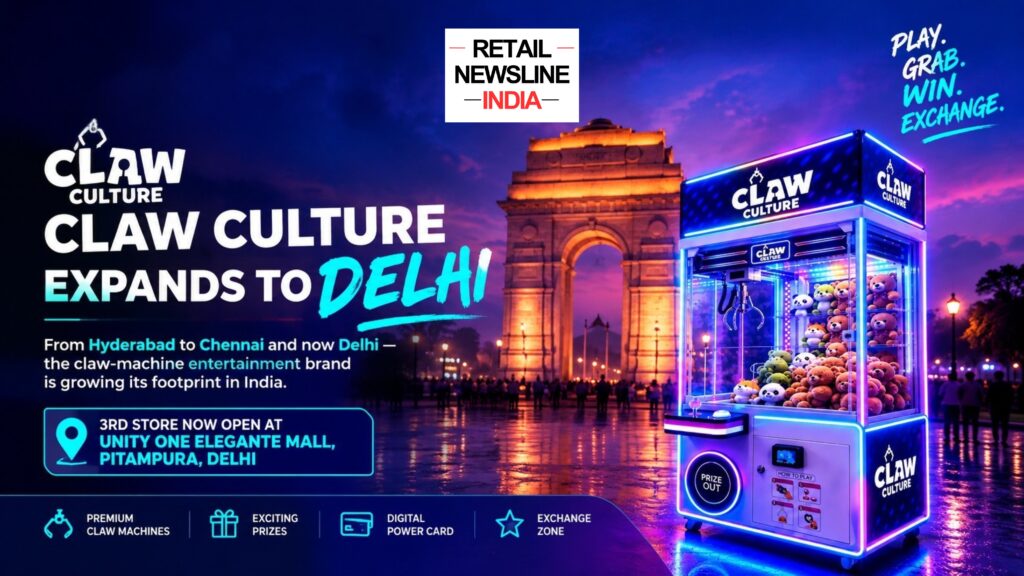
Claw Culture is expanding its experiential entertainment footprint in India, opening its third store at Unity One Elegante, Netaji Subhash Place, Pitampura, Delhi, following launches in Hyderabad and Chennai. The expansion marks another step in the brand’s ambition to build claw-machine entertainment as a distinct experiential category in India.
From Hyderabad to Chennai and now Delhi, Claw Culture is rapidly building a physical entertainment network around a simple proposition: Play. Grab. Win. Exchange.
The brand’s latest Delhi opening at Unity One Elegante, Netaji Subhash Place, Pitampura, makes it the company’s third store in India. A recent LinkedIn update from the Claw Culture and Landmark Leisure ecosystem described the Delhi opening as another milestone in the journey from “concept to culture.”
The Delhi expansion comes less than four months after Claw Culture launched its first destination in Hyderabad and only weeks after opening its flagship Chennai location at VR Mall.
The pace of rollout indicates that the company is moving quickly from concept validation to multi-city expansion.
Claw Culture Opens Its Third Store in Delhi
Claw Culture’s third location is now operational at Unity One Elegante, Netaji Subhash Place, Pitampura, New Delhi.
Recent recruitment information for the Delhi location identifies Unity One Elegante as the workplace for Claw Culture’s customer sales and operations team, providing additional evidence that the Delhi venue has moved beyond the earlier “coming soon” stage shown on the brand’s website.
The latest operational update from Landmark Group’s procurement and supply-chain network also specifically describes the Pitampura outlet as Store #3, highlighting sourcing, vendor coordination, inventory readiness and on-ground execution as important components of the rollout.
This is particularly relevant because Claw Culture’s expansion is not simply about installing arcade machines. Each location requires the brand to replicate an experiential format involving technology, interiors, machines, prize inventory, customer-service operations and the overall visual identity.
From Hyderabad to Chennai to Delhi
Claw Culture’s expansion journey has moved rapidly across three major Indian cities.
Hyderabad: Where the Concept Started
Claw Culture launched its first destination at Sarath City Capital Mall, Hyderabad, in May 2026.
The approximately 3,500-square-foot venue was positioned as a dedicated claw-machine entertainment destination rather than a conventional multi-format family entertainment centre.
The Hyderabad venue featured 70+ high-end claw machines, a digital-first GameCard system and a curated prize wall featuring collectibles, pop-culture merchandise and other rewards.
The company positioned the concept around Gen Z, millennials, families, collectors and pop-culture enthusiasts.
The idea was to take an activity traditionally associated with arcades and create an entire destination around it.
Chennai: The Second and Flagship Location
In August 2026, Claw Culture opened its second location at VR Mall Chennai.
The Chennai flagship spans approximately 1,836 square feet and features more than 60 claw machines across different difficulty levels and prize categories.
The venue includes:
- Premium claw machines
- Digital scoring and token systems
- Prize Gallery Wall
- Plush toys
- Gadgets
- Collectibles
- Limited-edition merchandise
- Lifestyle accessories
- Social-media-friendly interiors
- Different difficulty levels and prize tiers
The Chennai outlet was also delivered as a fast-track project. Project-related posts from the execution team describe a roughly 60-day journey involving planning, procurement, coordination, customised lighting, furniture, detailing, testing and handover.
Delhi: The Third Store
The latest expansion takes Claw Culture to Delhi’s Pitampura area, with the new venue at Unity One Elegante, Netaji Subhash Place.
The Delhi opening is strategically significant because it gives Claw Culture a presence in the National Capital Region after establishing its initial footprint in southern India.
It also provides the brand with an opportunity to test its concept with Delhi-NCR’s large youth, family and mall-going consumer base.
What Is Claw Culture?
Claw Culture describes itself as an immersive claw-machine entertainment experience rather than simply an arcade.
Its official positioning is built around:
Play → Grab → Win → Exchange
The company’s website says the experience is designed around challenging machines, high-value collectibles and the skill involved in timing and operating the claw.
This distinction is important.
Traditional family entertainment centres typically offer multiple formats such as rides, soft play, arcade games and other attractions. Claw Culture is taking the opposite approach by concentrating heavily on one entertainment format and attempting to turn it into a destination.
The company’s Hyderabad launch described this strategy as a claw-exclusive entertainment destination.
From Arcade Game to Experiential Entertainment Category
The larger business idea behind Claw Culture is to transform the claw machine from an individual arcade attraction into an entire customer experience.
Instead of simply playing a machine and leaving, customers can:
- Load a digital Power Card.
- Select a machine.
- Play the claw game.
- Win points or prizes.
- Exchange winnings through the Exchange Zone.
- Return to try different machines and prizes.
The company’s current website says its Power Card works across Claw Culture venues and can be preloaded for gameplay. It also says balances remain active for six months from the last use.
This creates a digital layer around the physical entertainment experience.
Claw Culture’s Power Card Model
One of the important elements of the business model is the Claw Culture Power Card.
Instead of relying on traditional physical tokens, customers can load their cards and use them to play.
The company’s current published packages include:
| Power Card | Games | Approx. cost per game |
| ₹1,000 | 11 | ₹91 |
| ₹1,500 | 18 | ₹83 |
| ₹2,500 | 33 | ₹76 |
| ₹3,500 | 50 | ₹70 |
| ₹5,000 | 80 | ₹63 |
These are the packages currently displayed on Claw Culture’s website and may change over time.
The cross-location nature of the Power Card also gives Claw Culture an opportunity to build repeat visits as the network expands.
A customer who initially plays in Hyderabad, for example, can potentially use the same ecosystem at another Claw Culture location.
The Exchange Zone Adds Another Layer
Claw Culture’s concept does not end when a customer successfully grabs an item.
The brand has created an Exchange Zone, where winnings can be exchanged for different prizes.
Its published prize categories include:
- Tech and gadgets
- Lifestyle products
- Plush toys
- Collectibles
- Kids’ products
- Sports and action products
- Games and entertainment products
Examples displayed by the brand include Bluetooth speakers, earbuds, laptop bags, mugs, toys, plush products, children’s accessories and sports items.
This prize ecosystem is an important part of the concept because it gives customers an additional reason to keep playing.
The machine is the attraction, but the prize is the aspiration.
Why Claw Culture Is Targeting Gen Z and Families
Claw Culture’s format is designed to sit at the intersection of gaming, entertainment, social media and retail.
The company has specifically identified:
- Gen Z
- Millennials
- Families
- Couples
- Collectors
- Pop-culture enthusiasts
- “Kidult” consumers
as relevant audiences.
The concept is particularly suited to social-media behaviour because the gameplay itself creates visual moments: the anticipation of a successful grab, the machine interaction, the reveal of a prize and the celebration that follows.
The Hyderabad launch highlighted the brand’s social-first approach, with illuminated machines, collectible displays and celebration zones designed to encourage content creation and sharing.
Why Mall Locations Matter
Claw Culture’s first three locations have all been associated with major mall and entertainment destinations:
Hyderabad: Sarath City Capital Mall
Chennai: VR Mall Chennai
Delhi: Unity One Elegante, Netaji Subhash Place
This location strategy is logical for an experiential entertainment concept.
Unlike conventional retail, where the consumer may visit specifically to purchase a product, entertainment formats depend heavily on footfall, dwell time, visibility and destination behaviour.
A mall environment allows Claw Culture to benefit from:
- Family visits
- Youth footfall
- Weekend traffic
- Cinema and dining traffic
- Shopping trips
- Group visits
- Birthday and celebration occasions
- Impulse entertainment decisions
The Delhi location at Pitampura consequently gives the brand access to a dense urban catchment and a mall-based entertainment environment.
Claw Culture Is Part of Landmark’s Broader Leisure Ecosystem
Claw Culture is associated with Landmark Leisure, part of the wider Landmark Group ecosystem.
Landmark Leisure already operates entertainment concepts in India, including Fun City, and the Claw Culture rollout demonstrates an extension into a more specialised, digitally enabled entertainment proposition.
LinkedIn profiles and project updates from the organisation identify Claw Culture alongside Landmark Leisure India and Landmark Group.
The company structure is also reflected in trademark records: a Claw Culture trademark application filed in October 2025 lists Citymax Hotels India Private Limited as the proprietor and covers games, toys, retail services and entertainment activities.
Silvio Liedtke and the Claw Culture Vision
Silvio Liedtke, CEO of Claw Culture, has been closely associated with the company’s market positioning.
At the Hyderabad launch, Liedtke said the company wanted to move beyond the conventional arcade model and create a new entertainment category around the claw-machine experience. He also pointed to the growing consumer interest in experiential entertainment and referenced international markets such as Tokyo, Seoul, Shanghai and Dubai as examples of the broader appeal of claw-machine entertainment.
At the Chennai launch, Liedtke again positioned Claw Culture as an experience combining play, discovery, collectability and the excitement of winning, rather than simply another arcade format.
The company’s approach therefore appears to be based on building a specialised entertainment brand rather than operating a generic gaming centre.
From Concept to Culture: The Execution Behind the Expansion
The phrase “From Concept to Culture” is particularly relevant to Claw Culture’s current stage.
Launching one entertainment venue can establish a concept.
Launching three locations across different cities in a short period requires something different: repeatable execution.
The Chennai project provides an example.
Project teams involved in the launch have highlighted the complexity of translating the Claw Culture design into a functioning venue, including:
- Customised LED design
- Specialised lighting
- Furniture and finishes
- Toy conveyor systems
- Multiple vendors
- Procurement
- Technical installation
- Project management
- Testing
- Store handover
- Operations readiness
A project post from the execution team described the Chennai store as a fast-track project completed in approximately 60 days.
The latest Delhi opening similarly highlights the importance of procurement and supply-chain execution, with sourcing, vendor coordination and inventory readiness forming part of the store rollout.
This means the growth story is not only about customer-facing entertainment. It is also about developing a scalable store-development engine.
Customer Experience Is at the Centre of the Model
Claw Culture’s expansion messaging repeatedly puts customer experience at the centre.
The brand’s official website describes the concept as more than a machine, emphasising the thrill of winning, the challenge of the game and the story associated with each prize.
Its stores are consequently designed around several experience layers:
Gameplay: The actual claw-machine challenge.
Discovery: Customers choose from multiple machines and prize categories.
Winning: Successful gameplay produces a tangible reward.
Exchange: Customers can use winnings in the Exchange Zone.
Social sharing: Store environments are designed to generate photographs and videos.
Repeat engagement: Digital cards, multiple machines and changing prize assortments encourage customers to return.
This creates a business model where the customer is not simply buying a product. The customer is paying for an experience with the possibility of a reward.
What Makes Claw Culture Different from a Traditional Arcade?
Claw Culture’s differentiation can be summarised in five areas.
1. Single-category focus
Rather than offering many unrelated arcade formats, the concept is built primarily around claw machines.
2. Premium prize ecosystem
The brand focuses on collectibles, gadgets, plush toys, lifestyle products and limited-edition merchandise.
3. Digital gameplay
The Power Card and digital scoring approach reduce dependence on traditional tokens.
4. Social-first store design
The interiors and machine layouts are designed to generate shareable moments.
5. Exchange-based rewards
The Exchange Zone adds another layer to the conventional claw-machine experience.
Together, these elements turn an arcade mechanic into a broader entertainment proposition.
Claw Culture’s Expansion Strategy
The progression from Hyderabad to Chennai and Delhi suggests that Claw Culture is pursuing a metro-first expansion strategy.
The company’s Hyderabad launch statement said it planned a nationwide expansion across major metropolitan cities over the following year.
The current footprint indicates that the company is following that direction:
South India: Hyderabad and Chennai
North India: Delhi-NCR
This gives Claw Culture an initial platform across different consumer markets while keeping the business concentrated in large urban entertainment destinations.
The next phase could therefore involve further metro expansion before moving into additional Tier-I and potentially Tier-II cities.
Why the Indian Claw-Machine Market Could Be Interesting
Claw machines have existed in India for years, but the Claw Culture proposition is attempting to elevate them from individual arcade attractions to a dedicated entertainment destination.
Several consumer trends support the opportunity:
Experiential spending
Young consumers increasingly spend on experiences rather than only physical products.
Social entertainment
Entertainment activities that can generate Instagram, YouTube and short-form video content have additional organic marketing potential.
Pop-culture collectibles
Plush toys, gadgets and licensed or trending merchandise create an additional emotional connection with customers.
Family entertainment
The format can work for children, teenagers, young adults and parents.
Mall transformation
Shopping centres increasingly need entertainment formats that increase dwell time and complement retail, food and cinema.
Claw Culture sits at the intersection of all five.
The Bigger Retail and Entertainment Opportunity
The rise of Claw Culture also reflects a broader evolution in India’s retail and mall ecosystem.
Physical retail is no longer only about selling products.
Modern shopping destinations are increasingly combining:
Retail + Food + Entertainment + Gaming + Experiences + Social Interaction
For malls, experiential formats can potentially increase the time consumers spend within a destination.
For brands, they create opportunities to build stronger emotional connections than traditional transactional retail.
For consumers, they provide reasons to visit physical destinations even when they are not planning to shop.
Claw Culture’s dedicated format is therefore relevant not only to the arcade industry but also to the broader evolution of experiential retail and entertainment in India.
What Comes Next for Claw Culture?
The Delhi launch could be an important indicator of what comes next.
With three stores now established, Claw Culture will need to demonstrate that the concept can be replicated while maintaining:
- Machine uptime
- Prize availability
- Consistent customer experience
- Store productivity
- Repeat visits
- Operational efficiency
- Safety and maintenance
- Attractive prize economics
- Digital engagement
- Strong mall partnerships
The company’s website already describes upcoming locations as part of its wider network and says the Power Card is intended to work across venues.
That cross-location infrastructure becomes increasingly valuable as the network grows.
From One Concept to a Scalable Entertainment Brand
Claw Culture’s journey from its first Hyderabad location to its Chennai flagship and now Delhi shows how quickly a new experiential entertainment concept can move from launch to expansion.
The first store proved the idea.
The second store expanded the format.
The third store begins to demonstrate repeatability.
The larger opportunity now is to determine whether Claw Culture can turn the excitement around claw-machine gaming into a recognisable nationwide entertainment brand.
From Hyderabad to Chennai to Delhi, the company is no longer simply introducing customers to claw machines.
It is attempting to build a culture around the experience.
And if the rollout continues at the current pace, the next chapter could take Claw Culture well beyond its first three cities and into India’s broader experiential entertainment market.
Claw Culture Locations in India
| City | Location | Status |
| Hyderabad | Sarath City Capital Mall, Kondapur | Open |
| Chennai | VR Mall Chennai, Vadapalani | Open |
| Delhi | Unity One Elegante, Netaji Subhash Place, Pitampura | Open |
The brand’s official website currently shows Hyderabad as open while its location page still displays Chennai and Delhi as “coming soon”, indicating that the website’s location information has not yet caught up with the latest store openings. Current LinkedIn and operational updates confirm the Chennai and Delhi openings.
Frequently Asked Questions (FAQ’s)
What is Claw Culture?
Claw Culture is a dedicated claw-machine entertainment brand focused on skill-based claw games, prizes, collectibles and an Exchange Zone. The company positions it as an immersive entertainment experience rather than a conventional arcade.
Where is Claw Culture located in India?
Claw Culture has locations in Hyderabad, Chennai and Delhi. The Hyderabad outlet is at Sarath City Capital Mall, the Chennai flagship is at VR Mall Chennai and the Delhi outlet is at Unity One Elegante, Netaji Subhash Place, Pitampura.
How many Claw Culture stores are there?
Claw Culture currently has three stores in India based on the latest expansion updates: Hyderabad, Chennai and Delhi. The Delhi outlet is identified as Store #3 in a recent Landmark Group supply-chain update.
Where did Claw Culture start?
Claw Culture launched its first destination at Sarath City Capital Mall in Hyderabad in May 2026.
When did Claw Culture open in Chennai?
Claw Culture opened its Chennai flagship at VR Mall Chennai on 14 August 2026. The outlet covers approximately 1,836 square feet and features 60+ claw machines.
Where is Claw Culture’s Delhi store?
The Delhi store is located at Unity One Elegante, Netaji Subhash Place, Pitampura, New Delhi.
Who is the CEO of Claw Culture?
Silvio Liedtke is identified as the CEO of Claw Culture and has spoken publicly about the brand’s vision for creating a new claw-machine entertainment category in India.
What can you win at Claw Culture?
Claw Culture’s prize ecosystem includes plush toys, collectibles, gadgets, lifestyle products, limited-edition merchandise, kids’ products and other rewards.
What is the Claw Culture Power Card?
The Power Card is Claw Culture’s digital gameplay card. Customers can preload it and use it for games across the brand’s venues. The company says the balance remains active for six months from the last use.
Is Claw Culture suitable for adults?
Yes. While children are an important audience, Claw Culture specifically targets teenagers, young adults, families, couples, collectors and pop-culture enthusiasts.