
August 12, 2026 | Retail Newsline India
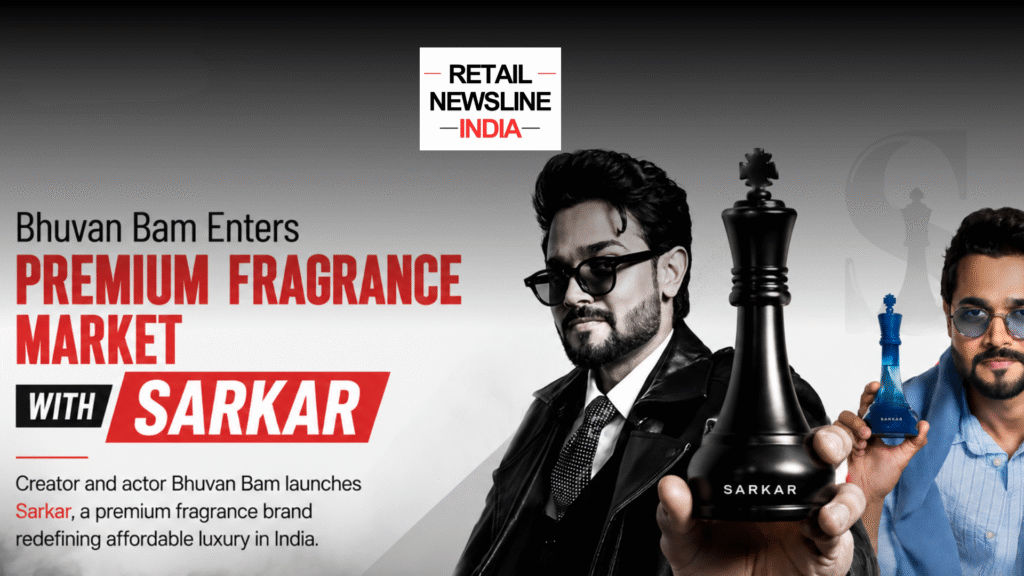
Actor and creator Bhuvan Bam has entered India’s growing premium fragrance market with SARKAR, a new creator-led perfume brand co-founded with entrepreneurs Neel Gogia, Rohit Raj and Jag Chima.
Positioned between mass-market body sprays and expensive niche fragrances, SARKAR is targeting consumers looking for premium-quality perfumes at a relatively accessible price point. The initial collection comprises four unisex fragrances, with pricing positioned broadly in the ₹1,000–₹2,000 range. The brand is being launched through its own digital channel as well as marketplaces including Amazon and Flipkart.
SARKAR Takes a Product-First Approach to Creator-Led D2C
The launch is notable because SARKAR is being positioned as more than a celebrity merchandise extension.
According to co-founder Neel Gogia, the brand was developed over approximately three years before its public launch. Gogia has described SARKAR as a venture built by two co-founder duos: Bhuvan Bam and Rohit Raj, alongside Neel Gogia and Jag Chima. (LinkedIn)
This approach reflects a broader evolution in India’s creator economy.
Instead of simply putting a celebrity name on an existing consumer product, creators are increasingly becoming entrepreneurs who participate in product development, brand positioning, distribution and customer acquisition.
For SARKAR, Bhuvan Bam’s substantial audience provides an important discovery and distribution advantage, while the founding team brings D2C and brand-building experience.
Four Fragrances Form the Initial SARKAR Collection
SARKAR has launched with four fragrances:
- Orion
- Noble
- Throne
- Regal
The fragrances are positioned as unisex offerings designed around different personalities, moods and occasions.
The collection is presented as 100 ml Eau de Parfum, with a reported 25% perfume-oil concentration. Public product discussions around the launch also identify the fragrances as the four initial variants available to consumers.
The brand’s positioning is aimed at consumers who want a stronger fragrance profile and premium presentation without moving into the significantly higher prices associated with many niche fragrance houses.
From Creator Influence to Consumer Brand
The bigger story behind SARKAR is arguably not the perfume itself but the changing role of creators in India’s consumer economy.
Bhuvan Bam already has significant brand recognition among India’s digital-first audiences. That gives SARKAR something traditional startups typically spend years trying to build: initial awareness and consumer attention.
But attention alone does not guarantee a sustainable consumer brand.
The long-term test will be whether customers continue purchasing SARKAR because they like the product, fragrance performance, packaging, pricing and overall brand experience, rather than simply because Bhuvan Bam is associated with it.
This distinction is becoming increasingly important as India’s creator-led D2C ecosystem expands.
Why Premium Fragrance Is Attracting New D2C Brands
India’s fragrance category is undergoing a significant transformation.
Perfume is increasingly being viewed not simply as a grooming product but as part of personal identity, lifestyle and self-expression.
Younger consumers are experimenting with:
- Premium perfumes
- Eau de Parfum formats
- Unisex fragrances
- Niche-inspired scents
- Layering
- Online fragrance discovery
- Premium packaging
- Direct-to-consumer fragrance brands
This creates an opportunity between inexpensive mass-market fragrances and highly expensive luxury or niche perfume houses.
SARKAR is attempting to occupy this middle ground.
Its proposition is essentially:
Premium fragrance experience + accessible pricing + creator-led brand discovery.
Global Fragrance Expertise Meets an Indian Brand Vision
The brand’s launch positioning also emphasizes international fragrance development.
The information provided by D2C Insider states that Orion, Noble and Throne were formulated in France, while Regal was formulated in Spain, bringing European fragrance expertise into an Indian consumer brand proposition.
The brand has also stated that its products comply with IFRA standards.
This global formulation narrative is important for SARKAR because the premium fragrance consumer is becoming increasingly knowledgeable about formulation, concentration, fragrance notes and manufacturing provenance.
Consumers today are not necessarily satisfied with simply seeing a celebrity’s name on a bottle.
They increasingly want to know:
What is inside the bottle?
How long does it last?
Where was it formulated?
How concentrated is the fragrance?
Is the price justified by the product experience?
That shift could make product quality one of the most important factors determining SARKAR’s long-term success.
SARKAR’s Distribution Strategy
The brand is taking an omnichannel-first approach from launch.
SARKAR’s products are being made available through its own online platform alongside major marketplaces including Amazon and Flipkart. (Reddit)
This strategy allows the company to combine:
D2C → Brand control and customer data
Marketplaces → Consumer reach and convenience
Creator distribution → Awareness and discovery
The combination could provide SARKAR with a strong launch funnel.
However, the next challenge will be moving consumers from first purchase to repeat purchase.
For fragrance brands, repeat buying is particularly important because customer retention can determine whether initial creator-driven attention develops into sustainable brand equity.
The Real Opportunity: Building a Fragrance Brand Beyond Bhuvan Bam
SARKAR’s biggest strategic opportunity may also be its biggest challenge.
Bhuvan Bam can help the brand get noticed.
But eventually, SARKAR needs to become bigger than its founder.
The strongest creator-led consumer brands eventually develop independent identities where consumers recognize the brand even when the creator isn’t actively promoting it.
That requires investment in:
- Product quality
- Distinctive fragrance profiles
- Strong packaging
- Consistent brand identity
- Customer reviews
- Repeat purchases
- Community building
- Retail distribution
- Product innovation
The brand’s three-year development period suggests that its founders are attempting to take a longer-term approach rather than treating the launch as a short-lived celebrity collaboration.
Creator-Led Brands Are Entering Their Next Phase
SARKAR’s launch is part of a much larger trend in India’s consumer market.
The creator economy is moving from:
Content → Audience → Influence → Products → Businesses
Creators who have built substantial communities can now use that distribution advantage to launch brands across categories such as beauty, fashion, personal care, food, wellness and lifestyle.
But the economics are changing.
Getting a product noticed is becoming easier.
Building a product people buy again without the creator’s influence is becoming the real benchmark.
SARKAR therefore represents an interesting case study in the evolution of India’s creator-led D2C ecosystem.
What SARKAR Means for India’s Premium Fragrance Market
The launch comes at a time when consumers are increasingly willing to trade up from basic personal-care products to more premium lifestyle experiences.
SARKAR’s affordable-premium positioning could help expand the addressable market for higher-concentration fragrances among consumers who may not be ready to spend luxury-level prices.
The brand is effectively betting on a simple consumer proposition:
You don’t have to pay luxury prices to experience a more premium fragrance.
If the product delivers on that promise, SARKAR could establish itself beyond the initial creator-led launch.
The Bigger Retail Takeaway
For the Indian retail and D2C ecosystem, SARKAR highlights a fundamental change in how consumer brands are being built.
Traditional brands often followed:
Product → Distribution → Advertising → Awareness
Creator-led brands can increasingly follow:
Audience → Trust → Product → Community → Distribution → Repeat Purchase
That creates a significant competitive advantage at launch.
But the advantage only lasts if the product delivers.
SARKAR now has the attention.
The next question is whether it can convert that attention into brand loyalty, repeat purchases and long-term consumer trust.
The Indian fragrance market will be watching.
Key Takeaways
- Bhuvan Bam has entered the premium fragrance category with SARKAR.
- SARKAR is co-founded by Bhuvan Bam, Neel Gogia, Rohit Raj and Jag Chima.
- The brand launches with four unisex fragrances: Orion, Noble, Throne and Regal.
- The collection is positioned in the affordable-premium segment.
- The fragrances are reported to feature 25% perfume-oil concentration.
- SARKAR has been developed over approximately three years.
- The brand combines creator distribution with a D2C and marketplace strategy.
- The long-term challenge will be building brand equity beyond Bhuvan Bam’s personal influence.
Frequently Asked Questions
What is SARKAR by Bhuvan Bam?
SARKAR is a premium fragrance brand co-founded by Bhuvan Bam with Neel Gogia, Rohit Raj and Jag Chima.
What perfumes does SARKAR offer?
The initial SARKAR collection includes Orion, Noble, Throne and Regal.
What is the price range of SARKAR perfumes?
The initial collection is positioned broadly in the ₹1,000–₹2,000 range, placing it in the affordable-premium fragrance segment.
Are SARKAR fragrances unisex?
Yes. The initial collection has been positioned as a range of unisex fragrances.
Where can consumers buy SARKAR perfumes?
The brand is available through its own online channel and marketplaces including Amazon and Flipkart.
What makes SARKAR different from a typical celebrity fragrance?
SARKAR is being positioned as a standalone consumer brand with a multi-founder team and a product-first approach, rather than simply as celebrity merchandise.
Why is Bhuvan Bam entering the fragrance industry?
The move allows Bam to extend his creator-led personal brand into a consumer category while leveraging his existing audience and distribution reach.
What is the biggest challenge for SARKAR?
The key challenge will be converting creator-driven awareness into independent brand equity, customer satisfaction and repeat purchases.