
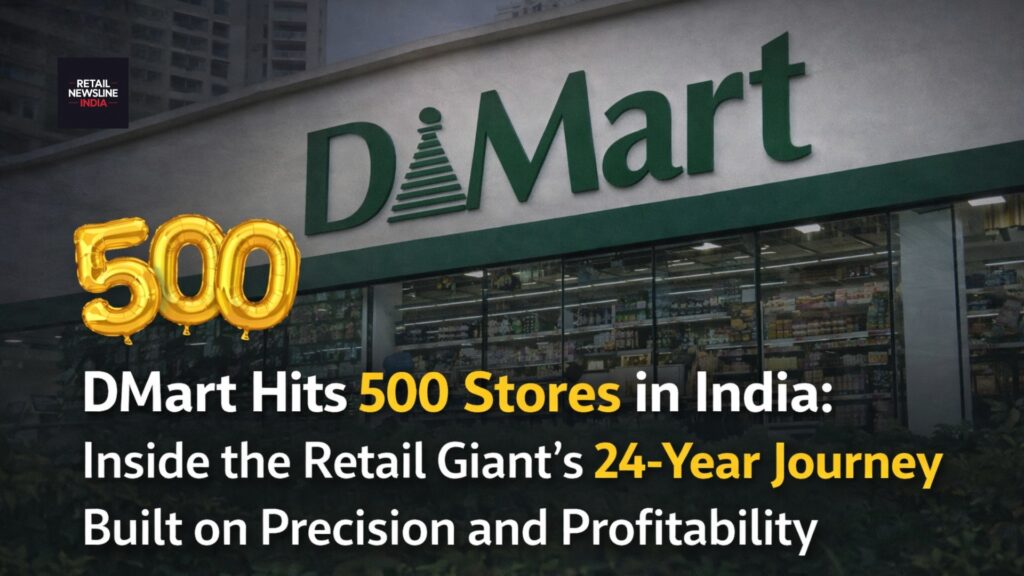
India’s leading value retail chain Dmart has reached a major milestone with the opening of its 500th store in Avadi, Chennai, marking the culmination of a 24-year journey defined by discipline, cost efficiency, and consumer trust.
Owned by Avenue Supermarts, DMart’s expansion story stands apart in a sector often driven by aggressive scaling and heavy marketing. Instead, the retailer has built its leadership position through precision-led growth and a relentless focus on fundamentals.
A Beginning Rooted in Clarity
The journey of DMart began in 2002, when veteran investor Radhakishan Damani opened the first store in Powai, Mumbai.
At a time when organized retail in India was experimenting with premium experiences and aspirational formats, Damani took a contrarian approach.
Instead of focusing on ambiance and experience, DMart focused on price leadership.
The insight was simple yet powerful: Indian consumers value savings over experience, especially in essential categories like groceries and household items.
Growing Quietly, Compounding Relentlessly
Over the next two decades, DMart expanded steadily across:
- Maharashtra
- Gujarat
- Southern India
- Northern India
Unlike competitors, DMart adopted a cluster-based expansion strategy, ensuring operational efficiency and profitability before entering new markets.
There were:
- No aggressive nationwide rollouts
- No experimental store formats
- No distraction from core operations
Each store replicated a proven, optimized model, enabling consistent performance across locations.
By the time Avenue Supermarts went public in 2017, DMart had already established itself as a profitable and capital-efficient retail business.
DMart at 500: Scale Meets Structure
As of 2026, DMart’s operational footprint reflects disciplined scaling:
- Total Stores: 500
- Average Store Size: 30,000–35,000 sq. ft.
- Total Retail Space: ~15–17 million sq. ft.
- Product Range: 6,000–8,000 SKUs
- Core Categories: Food & Grocery, FMCG, Home Essentials, Apparel
This scale has been achieved without compromising on efficiency or profitability.
The Store Philosophy: Function Over Form
A typical DMart store is designed for throughput, not aesthetics.
Customers encounter:
- Dense shelving
- Minimal visual merchandising
- Visible price advantages
This operational simplicity reduces costs and enables the brand to offer consistently lower prices.
Real Estate Strategy: Ownership as Advantage
One of DMart’s biggest differentiators is its preference for owning store properties rather than leasing them.
This strategy delivers:
- Lower long-term costs
- Protection from rental inflation
- Stronger operating margins
In a retail market where rentals significantly impact profitability, this approach has provided DMart with a structural competitive advantage.
The Business Model: Precision Over Proliferation
The success of DMart lies in its highly optimized operating model.
Everyday Low Pricing (EDLP)
DMart follows a consistent low-price strategy instead of periodic discounts, building deep consumer trust.
Limited Assortment
With 6,000–8,000 SKUs, the assortment is tightly curated to:
- Improve inventory turnover
- Strengthen supplier negotiations
- Maximize shelf productivity
Lean Operations
Costs are controlled at every level, ensuring sustainable profitability.
Financial Performance: Consistency at Scale
Avenue Supermarts continues to deliver strong financial performance:
FY26 Snapshot
Q3 FY26
- Revenue: ~₹18,100 crore (+13% YoY)
- Net Profit: ~₹856 crore (+17–18% YoY)
- EBITDA Margin: ~8.1%
9M FY26
- Revenue: ~₹49,700+ crore (~15% YoY growth)
The key highlight is not just growth, but consistency across economic cycles.
Leadership: Execution at the Core
While Radhakishan Damani defined the philosophy, it was Neville Noronha who operationalized it.
Joining in 2004, Noronha played a critical role in scaling DMart by focusing on:
- Operational discipline
- Vendor relationships
- Cost efficiency
- Cluster-based growth
Under his leadership, DMart evolved into a national retail benchmark.
Leadership Transition: Continuity Over Change
The recent transition to Anshul Asawa as CEO marks a new phase for DMart.
With prior experience at Hindustan Unilever, Asawa inherits a business that is:
- Financially strong
- Operationally efficient
- Strategically clear
The focus will remain on measured growth and long-term value creation.
Consumer Trust: DMart’s Strongest Asset
In a retail environment dominated by:
- Flash sales
- Discounts
- App-based commerce
DMart offers predictability.
Customers trust that:
- Prices will remain low
- Products will be consistently available
- Value will not fluctuate
This has created deep loyalty, especially among India’s middle-class households.
DMart Operating Blueprint
ParameterDMart StrategyBusiness ImpactPricingEveryday Low PricingRepeat footfallAssortmentLimited SKUsHigher efficiencyReal EstateOwned storesCost stabilityExpansionCluster-basedOperational controlInventoryHigh turnoverStrong cash flows
Beyond 500 Stores: What’s Next?
As DMart crosses the 500-store milestone, future growth is expected to come from:
- Expansion in southern and eastern India
- Strengthening owned real estate portfolio
- Scaling digital platform (DMart Ready)
- Private label growth
However, expansion will remain measured and disciplined.
Conclusion
The journey of DMart is not about rapid disruption—it is about consistent execution.
In a market driven by speed, DMart has chosen patience. In an industry chasing growth, it has prioritized profitability.
And in doing so, it has built something rare:
A retail institution grounded in trust, discipline, and long-term thinking.
Frequently Asked Questions (FAQs)
1. What is DMart?
DMart is a leading Indian retail chain focused on value pricing and essential goods.
2. How many stores does DMart have in India?
As of 2026, DMart operates 500 stores across India.
3. Who founded DMart?
DMart was founded by Radhakishan Damani in 2002.
4. What is DMart’s business model?
It follows an Everyday Low Pricing strategy with cost-efficient operations and owned real estate.
5. Who is the current CEO of DMart?
Anshul Asawa is the current CEO.