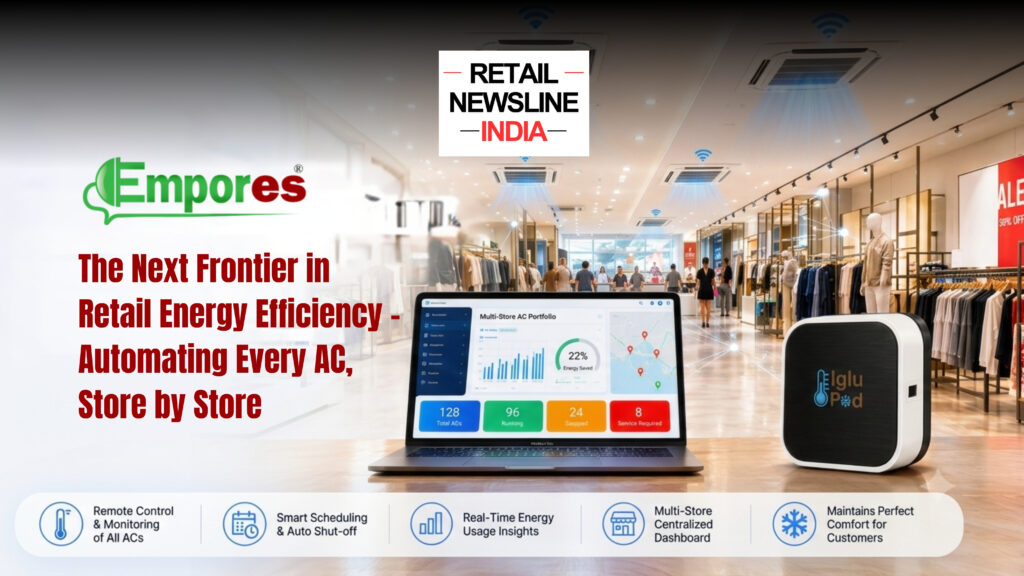
Empores LLC is advancing smart AC automation for chain retailers through IGLUPOD®, an IoT-enabled solution designed to help businesses automate HVAC operations, reduce unnecessary AC operating hours and move from energy monitoring to actionable energy management.
For modern retailers, electricity is no longer simply a line item on the monthly operating statement. As store networks expand across cities, formats and climate zones, energy management is increasingly becoming a strategic lever for improving store-level profitability and operational efficiency.
Among the biggest and most persistent energy loads in retail is air conditioning.
A single store may operate multiple air-conditioning units for long hours every day. Multiply that across 100, 500 or 1,000 outlets, and even a relatively small amount of unnecessary AC operation can translate into a substantial recurring energy cost.
This is where smart AC automation is emerging as a practical opportunity for retailers.
Empores LLC, an energy-efficiency technology company focused on connected solutions for commercial and retail environments, is addressing this challenge through IGLUPOD® – Smart AC Automation & Control. The solution is designed to help businesses automate air-conditioning operations using an IoT-enabled approach, enabling retailers to align AC usage more closely with store operating schedules.
The larger proposition is not simply about switching air conditioners off.
It is about creating a more systematic way to control when, where and how cooling equipment operates across an entire retail network.
Retail Energy Management Is Moving Beyond Monitoring
Retailers have traditionally relied on electricity bills, energy meters and periodic reports to understand their consumption.
These tools can answer an important question:
How much electricity did a store consume?
But for a multi-store retail organization, that is only the beginning.
The more actionable questions are:
- Which stores are consuming more energy than expected?
- When are ACs operating?
- Are air conditioners running before stores open?
- Do ACs continue operating after closing?
- Are units running during low-occupancy periods?
- How consistently are store teams following operating schedules?
- Which energy-consuming systems can be automated?
- Can energy-saving practices be standardized across hundreds of locations?
The difference between monitoring energy consumption and actively managing energy consumption can be significant.
This is the opportunity that Empores LLC is targeting with IGLUPOD®.
What Is IGLUPOD®?
IGLUPOD® is Empores LLC’s smart AC automation and control solution designed for commercial and retail environments.
The IoT-enabled approach allows retailers to move away from relying entirely on manual AC switching and individual store-level intervention.
Instead, businesses can establish automated operating schedules so that air-conditioning operation is better aligned with store requirements.
The underlying principle is straightforward:
The objective is not simply to switch ACs OFF. The objective is to make every unit operate when it is actually required.
For retailers, that distinction is important.
Energy efficiency should not come at the expense of customer comfort or store operations. Instead, automation can help create a more disciplined operating framework in which cooling is available when needed while unnecessary operating hours are minimized.
The Hidden Cost of Manual AC Management
Consider a typical retail environment.
A store opens at 10 a.m., but several air-conditioning units may be switched on much earlier because employees arrive before opening.
At the other end of the day, staff may begin closing activities at 9 p.m., while AC units continue operating until someone remembers to switch them off.
On another day, a store may have lower customer traffic, yet its HVAC equipment continues following the same operating pattern.
Individually, these situations may appear insignificant.
Across a large store network, however, the cumulative impact can become much more meaningful.
The challenge becomes even more complex when retailers operate across different cities and regions, because stores can have different:
- Operating hours
- Store formats
- Customer traffic patterns
- Weather conditions
- Occupancy levels
- HVAC configurations
- Staff practices
- Opening and closing routines
Manual intervention makes standardization difficult.
Automation creates the possibility of standardizing the process.
From Manual Switching to Automated AC Scheduling
One of the central applications of IGLUPOD® is automated AC scheduling.
Rather than making store employees responsible for remembering when each air-conditioning unit needs to be switched on or off, retailers can establish operating schedules aligned with business requirements.
This can help address situations such as:
Pre-opening operation: ACs operating unnecessarily long before customers arrive.
Post-closing operation: Cooling continuing after the store has closed.
Low-occupancy periods: Equipment operating without corresponding customer or operational requirements.
Inconsistent employee practices: Different stores following different AC operating routines.
Automation can introduce greater consistency into these processes.
For a retailer managing hundreds of stores, consistency itself can become an important operational advantage.
Centralized Visibility With Store-Level Control
Managing HVAC equipment across a large retail network presents a different challenge from managing a single store.
Facilities teams may have to oversee hundreds of outlets distributed across multiple cities.
Without connected systems, obtaining visibility into AC operations can require store-level communication, manual checks or fragmented information.
An IoT-enabled approach can help organizations create a more connected operating environment.
The broader objective is to enable management teams to move toward:
- Automated AC scheduling
- Centralized visibility
- Reduced unnecessary operating hours
- Better operational consistency
- Reduced energy wastage
- Improved facility management
- Scalable energy optimization
- More structured HVAC operations across locations
This changes the role of the facilities team.
Instead of repeatedly asking individual stores to follow energy-saving instructions, organizations can increasingly build those practices into the operating system itself.
Why Smart AC Automation Matters for Chain Retailers
The business case becomes particularly relevant for retailers with large physical footprints.
Retail stores are energy-intensive environments because they require lighting, HVAC, refrigeration, digital systems, signage and other electrical infrastructure to operate throughout the business day.
Among these, HVAC can represent a significant recurring load, particularly in regions where air conditioning is required for extended periods.
For a chain retailer, therefore, energy optimization cannot be viewed only at the individual-store level.
The real opportunity lies in network-level optimization.
If an operating improvement can be implemented at one store and then replicated across hundreds of locations, the potential impact becomes considerably larger.
This creates a simple but powerful framework:
Measure → Automate → Optimize → Scale
The first step is understanding consumption and operations.
The second is identifying processes that can be automated.
The third is optimizing how those systems operate.
The fourth is scaling successful practices across the wider store network.
Energy Efficiency Should Not Depend on Employee Memory
One of the strongest arguments for automation is operational consistency.
A retailer can have excellent energy-efficiency policies on paper, but implementation can vary from one outlet to another.
Different employees may have different habits.
Some may switch ACs on early.
Others may forget to turn them off.
Some stores may follow closing procedures precisely.
Others may not.
For a business with hundreds of locations, relying entirely on human intervention can create variability.
Automation addresses this by shifting energy management from a behavior-dependent process to a system-driven process.
As the Empores LLC spokesperson explains:
“Energy efficiency in retail should not depend on someone remembering to switch an AC OFF. It should be built into the way every store operates.”
That philosophy is central to the IGLUPOD® proposition.
From One Store to an Entire Retail Network
The scalability of automation is particularly important for large retailers.
A solution does not necessarily create its greatest value by optimizing one location.
Its larger potential comes when the same operating model can be replicated across an entire network.
For example, a retailer could establish standardized AC schedules based on store operating hours and then deploy the approach across multiple outlets.
As the retailer expands, the same framework can potentially be extended to new locations.
This creates a more scalable approach to energy management than relying on individual store teams to implement different processes.
The model becomes:
One store → Multiple stores → Regional network → Enterprise-wide deployment
That scalability is particularly relevant as organized retail continues to expand beyond major metros into Tier 2 and Tier 3 cities.
Retailers Need More Than Electricity Reports
For business leaders, energy data has traditionally been used primarily for reporting and monitoring.
But the next stage of energy management is likely to focus increasingly on action.
A report can tell a retailer that electricity consumption increased.
An automated system can help address the operational processes contributing to that consumption.
This is why the shift from energy monitoring to energy management is important.
Retailers don’t necessarily need another electricity report.
They need greater control over the energy-consuming systems behind every store.
That includes understanding not just consumption levels, but also the operational behavior of equipment.
A Broader Energy-Efficiency Ecosystem
Empores LLC’s vision extends beyond air conditioning.
The company is focused on connected energy technologies across areas including:
- HVAC
- Energy monitoring
- Refrigeration
- Electrical infrastructure
- Connected energy management
This broader approach is significant because retail stores rarely have a single source of energy consumption.
A comprehensive energy-management strategy can potentially bring multiple systems into a connected ecosystem.
In such an environment, HVAC automation becomes one component of a wider digital energy-management architecture.
The long-term opportunity is to make the physical infrastructure of retail stores more intelligent, connected and responsive to actual operating requirements.
The Future of Retail Energy Management
The future of retail energy efficiency will not necessarily depend only on purchasing newer or more efficient equipment.
There is another opportunity:
Make existing equipment smarter.
Retailers already have substantial investments in air-conditioning systems, refrigeration, lighting and electrical infrastructure.
Connecting these assets to smarter control systems can potentially help businesses improve how existing equipment is operated.
This creates a different approach to energy efficiency.
Instead of asking only:
“How can we replace our equipment?”
businesses can also ask:
“How can we operate the equipment we already have more intelligently?”
For large retail networks, this distinction could become increasingly important.
The Role of IoT in Retail Energy Optimization
The Internet of Things is changing how physical assets can be monitored and controlled.
Connected devices can create communication between equipment, control systems and management platforms.
For retail organizations, this can create opportunities to connect physical store infrastructure with centralized operational strategies.
In the case of smart AC automation, IoT can help create a bridge between:
Store operations → AC equipment → Automated schedules → Centralized management
This connected model can reduce dependence on manual processes and provide a more structured approach to HVAC management.
The result is a move toward smarter stores where energy-consuming equipment is increasingly managed as part of a connected operational environment.
Why This Is Becoming a Boardroom Issue
Energy efficiency was once largely treated as a facilities-management responsibility.
Today, the conversation is increasingly connected to broader business priorities.
Retail leaders are looking at:
- Store profitability
- Operating expenses
- Sustainability
- Digital transformation
- Infrastructure efficiency
- Asset utilization
- Operational standardization
Energy consumption touches several of these areas.
When multiplied across hundreds of stores, even relatively small improvements in operational discipline can become financially relevant.
That is why smart energy management is increasingly moving from the facilities department toward the strategic agenda.
Empores LLC’s Vision for Smarter Retail Infrastructure
Empores LLC is positioning IGLUPOD® within a broader vision of connected energy management for commercial businesses.
The company’s approach focuses on helping organizations transition from simply knowing how much energy they consume to actively managing how energy-consuming infrastructure operates.
For retailers, this means looking at energy not simply as a cost to be reported, but as an operational variable that can potentially be measured, controlled and optimized.
The company’s spokesperson summarizes the vision:
“Our vision with IGLUPOD® is to help retailers move from manual HVAC control to connected, automated energy management—store by store, and ultimately across the entire retail network.”
What Smart AC Automation Could Mean for Retailers
For retailers evaluating HVAC automation, the potential benefits can be summarized around five areas:
1. Automation
AC operations can be aligned with defined store schedules rather than relying completely on manual switching.
2. Consistency
Standardized operating strategies can potentially be implemented across multiple outlets.
3. Visibility
Connected systems can provide management teams with greater visibility into HVAC operations.
4. Scalability
A model established at one location can potentially be extended across an entire store network.
5. Operational Efficiency
Reducing unnecessary AC operating hours can help retailers identify opportunities to improve energy efficiency and manage recurring operating costs.
Importantly, actual savings will depend on factors such as store size, climate, HVAC equipment, operating hours, occupancy, existing controls and implementation methodology. Smart automation should therefore be evaluated as an operational optimization strategy rather than as a guaranteed percentage reduction in electricity costs.
The Bigger Opportunity: Turning Stores Into Smarter Buildings
The emergence of smart AC automation points toward a broader transformation in physical retail.
Tomorrow’s store may not simply be a place where customers purchase products.
It can increasingly become a connected physical environment where HVAC, lighting, refrigeration, electricity, security and other infrastructure work within a digitally managed ecosystem.
For retailers with extensive physical networks, this creates an opportunity to move toward smarter infrastructure without necessarily waiting for complete store reconstruction.
The evolution can happen incrementally:
Monitor → Connect → Automate → Optimize → Scale
And HVAC can be one of the most practical places to begin.
Conclusion: From Energy Consumption to Energy Control
For India’s expanding retail networks, energy efficiency is becoming too important to leave entirely to manual processes.
Every additional store adds another set of air-conditioning units, operating hours, employees and daily routines that need to be managed.
At one store, an AC running for an extra hour may appear insignificant.
Across hundreds of stores, those hours can become a recurring operational issue.
Empores LLC’s IGLUPOD® seeks to address this challenge by bringing IoT-enabled automation into retail AC management.
The larger opportunity is not simply reducing the number on an electricity bill.
It is creating a retail operating environment in which energy-consuming equipment can be scheduled, connected, controlled and optimized systematically.
The question for retailers is therefore evolving.
It is no longer only:
“How much electricity did our stores consume?”
It is becoming:
“Where are we consuming energy, when are we consuming it, and what can we automate today?”
That shift—from monitoring consumption to actively managing energy—could become an important next step in the evolution of energy-efficient retail.
For chain retailers, the future may not be about managing energy store by store manually.
It may be about automating every AC, store by store, until the entire retail network operates smarter.
About Empores LLC
Empores LLC is an energy-efficiency technology company focused on helping commercial and retail businesses monitor, automate and optimize energy consumption through connected IoT and AI-enabled solutions. Its technology vision spans HVAC, energy monitoring, refrigeration and electrical infrastructure.
Brand / Solution: IGLUPOD® – Smart AC Automation & Control
Company: Empores LLC
Website: Empores LLC
Contact: Arun Pandian E
Phone: +91 8637447639
Email: Arun@emporesllc.com
LinkedIn: Arun Pandian E on LinkedIn