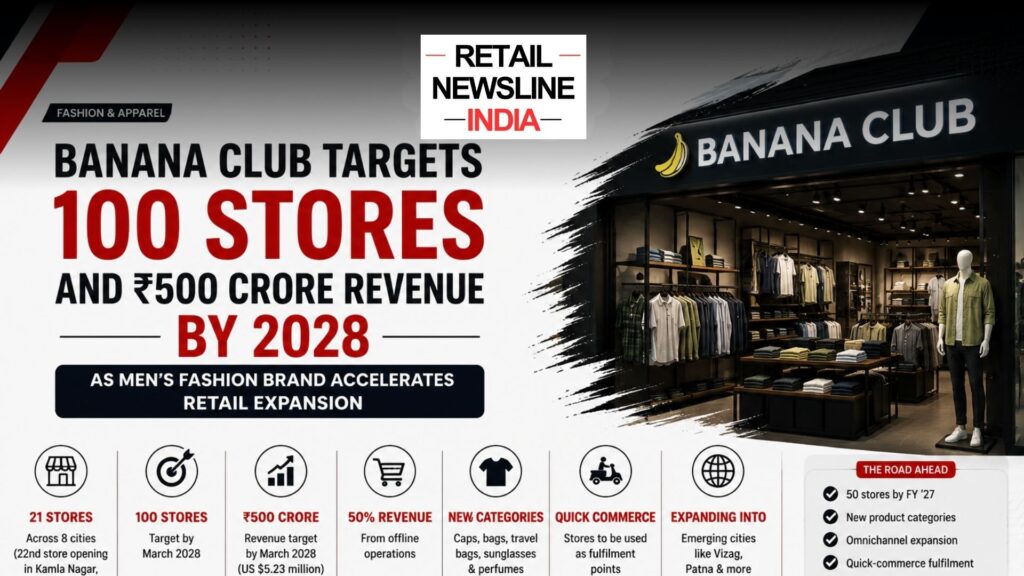
Men’s fashion brand Banana Club is stepping up its retail expansion strategy with plans to build a 100-store network and achieve ₹500 crore in revenue by 2028.
The brand, which currently operates 21 stores across eight cities, is targeting rapid offline expansion while simultaneously broadening its product portfolio, entering emerging markets and developing an omnichannel model that could eventually support quick-commerce fulfilment.
Banana Club is preparing to open its 22nd store in Kamla Nagar, Delhi, as it moves towards its target of 50 stores by FY27. The company then plans to add another 50 outlets by March 2028, taking its total store network to 100.
The expansion marks a significant shift for the brand as it looks to build a larger physical retail presence alongside its existing online business.
Banana Club’s Store Expansion Plan
Banana Club currently operates 17 company-owned stores and four franchise outlets across eight cities.
The brand is following a location-first expansion strategy, with the focus on identifying markets where it sees strong potential for men’s fashion consumption rather than limiting growth to traditional metropolitan markets.
For FY27, Banana Club has already signed letters of intent (LOIs) for 15 stores, while discussions are underway for another 15 locations.
The company aims to reach:
- 21 stores currently
- 22nd store coming up in Kamla Nagar, Delhi
- 50 stores by FY27
- 100 stores by March 2028
- 17 company-owned stores currently
- 4 franchise stores currently
- 15 FY27 locations backed by signed LOIs
- 15 additional locations under discussion
This approach is expected to give Banana Club a broader physical footprint while allowing the brand to test and scale markets based on local consumer demand.
Banana Club Looks Beyond Metro Markets
While Banana Club continues to expand in established markets, the company is also looking at emerging cities such as Vizag and Patna.
The move reflects a broader opportunity for fashion brands to expand beyond India’s largest metros as consumers in Tier 2 and emerging cities increasingly seek branded fashion and contemporary styles.
Banana Club’s average selling price of around ₹1,300 is also an important part of its expansion strategy.
According to co-founder Prashant Lalwani, the brand sees opportunities across both metro and emerging markets.
“We are not shying away from Metro & Tier 1 cities because our average selling price is around Rs 1,300, and we see a strong customer opportunity there.”
For Banana Club, the strategy is therefore not simply about moving into smaller cities. It is about building a wider national retail network while maintaining its presence in high-value urban markets.
Banana Club’s Revenue Target: ₹500 Crore by 2028
Banana Club is targeting ₹500 crore in revenue by March 2028, significantly higher than its current scale.
The brand generated approximately ₹106 crore in revenue in the previous financial year and is currently operating at a revenue run rate of around ₹150 crore.
Its near-term target is to reach ₹200 crore in revenue by March 2027 before accelerating towards the ₹500 crore target by 2028.
Achieving this growth will require Banana Club to scale both its store network and digital business while increasing productivity from each customer and location.
Offline and Online Revenue Are Currently Balanced
Banana Club currently generates approximately 50% of its revenue from offline operations and 50% from online channels.
Its own website contributes around 25% of total revenue, while marketplaces contribute another 25%.
At present, Myntra is the brand’s only marketplace.
This gives Banana Club a relatively balanced online-offline revenue structure as it prepares for a significantly larger physical footprint.
The planned expansion could further strengthen offline revenue while the company’s omnichannel investments are designed to make its stores and digital channels work together rather than operate as separate businesses.
Banana Club Expands Beyond Core Menswear
Banana Club’s product portfolio has traditionally focused on men’s fashion categories such as:
- Shirts
- Pants
- Bottoms
- Tops
However, the company is now expanding into a wider lifestyle portfolio.
New categories include:
- Caps
- Bags
- Travel bags
- Sunglasses
- Perfumes
The brand plans to launch its perfume range by Diwali, adding another category to its growing portfolio.
Shirts currently remain the largest revenue contributor, accounting for approximately 50–55% of Banana Club’s revenue. Bottoms and accessories follow.
The category expansion could help the brand increase basket sizes and encourage existing customers to purchase across multiple product categories.
Banana Club’s AOV Shows Difference Between Offline and Online Customers
Banana Club’s average order value varies significantly between its physical and digital businesses.
The company currently records an approximate:
- ₹3,300 offline AOV
- ₹2,000 online AOV
- ₹560 online customer acquisition cost
The higher offline AOV highlights the potential economic importance of Banana Club’s planned store expansion.
As the company moves towards 100 stores, improving store productivity and using physical locations to support digital orders could become increasingly important to its growth model.
Quick Commerce Could Become a New Retail Growth Channel
One of the more significant elements of Banana Club’s expansion strategy is its plan to use larger stores as fulfilment points for quick-commerce orders.
Instead of viewing stores only as customer-facing retail locations, the brand is exploring how its physical network can also function as a distributed fulfilment infrastructure.
Under this model, larger Banana Club stores could potentially help fulfil nearby online orders, allowing the brand to reduce delivery distances and improve fulfilment speed.
This strategy fits into Banana Club’s broader plans to develop its own omnichannel capabilities, integrating physical stores and online operations.
As the store network expands, the company could have a larger geographic footprint from which to serve digital customers.
Banana Club Is Building an Omnichannel Retail Model
Banana Club’s next phase of growth is increasingly centred around combining offline and online retail.
The company’s omnichannel strategy is expected to connect:
Stores + Website + Marketplace + Quick Commerce + Fulfilment
The objective is to create a retail ecosystem where physical stores can contribute not only to walk-in sales but also to online fulfilment and customer acquisition.
For a fashion brand targeting 100 stores, this could become an important component of improving the productivity of its retail footprint.
Banana Club’s Product Mix Is Still Led by Shirts
Despite the expansion into accessories and lifestyle categories, shirts remain the core of Banana Club’s business.
Shirts currently contribute approximately 50–55% of total revenue.
The company’s expansion into accessories, bags, sunglasses and perfumes is therefore expected to diversify its revenue mix over time.
The new categories also give Banana Club opportunities to build larger baskets around its core menswear customer.
For example, a customer purchasing shirts and bottoms could also be introduced to accessories, travel products, eyewear or fragrances.
Banana Club Plans Potential Fundraise
Alongside its retail and product expansion plans, Banana Club is also in discussions with several venture capital firms for a potential fundraise.
The company has so far raised capital only from family and friends.
A potential institutional fundraise could provide additional capital for store expansion, inventory, technology, marketing, product development and omnichannel infrastructure.
However, the company is still in discussions with investors, and no fundraise has been confirmed based on the information available.
What Banana Club’s 2028 Strategy Means for India’s Men’s Fashion Market
Banana Club’s expansion reflects the changing competitive landscape of India’s men’s fashion market.
The brand is pursuing growth across multiple dimensions at the same time:
Retail expansion: 21 stores today to 100 by March 2028.
Geographic expansion: Greater focus on emerging cities alongside metros and Tier 1 markets.
Category expansion: Moving beyond core apparel into accessories, eyewear, bags and fragrances.
Digital growth: Maintaining a 50% online revenue contribution.
Omnichannel retail: Connecting stores and digital operations.
Quick commerce: Exploring stores as fulfilment points for faster online deliveries.
Revenue growth: Targeting ₹200 crore by March 2027 and ₹500 crore by 2028.
The combination suggests that Banana Club is moving from a primarily fashion-led D2C model towards a broader omnichannel fashion retail business.
Banana Club’s Road Ahead
The next two years will be critical for Banana Club as it attempts to scale from 21 stores to 100 while more than tripling its revenue from the current run rate of around ₹150 crore.
The immediate milestones are clear: open the upcoming Kamla Nagar store, reach 50 stores by FY27, achieve ₹200 crore in revenue by March 2027 and then build towards 100 stores and ₹500 crore in revenue by March 2028.
The success of the strategy will depend on how effectively Banana Club manages store economics, inventory, customer acquisition, product diversification and the integration of offline and online channels.
With emerging cities, new product categories and quick-commerce fulfilment now part of its growth roadmap, Banana Club is positioning itself for a much larger presence in India’s fast-growing men’s fashion and lifestyle market.
Frequently Asked Questions
How many stores does Banana Club currently have?
Banana Club currently operates 21 stores across eight cities, including 17 company-owned stores and four franchise outlets.
How many stores will Banana Club have by 2028?
Banana Club plans to reach 100 stores by March 2028. It is targeting 50 stores by FY27 and plans to add another 50 stores by March 2028.
What is Banana Club’s revenue target for 2028?
Banana Club is targeting ₹500 crore in revenue by March 2028. Its near-term target is ₹200 crore by March 2027.
Where is Banana Club expanding?
Banana Club is expanding across metro, Tier 1 and emerging cities. Vizag and Patna are among the emerging markets being considered.
What products does Banana Club sell?
Banana Club’s core categories include shirts, pants, bottoms and tops. It is expanding into caps, bags, travel bags, sunglasses and perfumes.
When will Banana Club launch perfumes?
Banana Club plans to launch its perfume range by Diwali.
Where does Banana Club generate its revenue?
Approximately 50% of Banana Club’s revenue comes from offline operations and 50% from online operations. Its website contributes around 25% of total revenue, while marketplaces contribute another 25%.
Which marketplace sells Banana Club?
Banana Club is currently available on Myntra as its marketplace channel.
What is Banana Club’s average order value?
Banana Club’s average order value is approximately ₹3,300 offline and ₹2,000 online.
What is Banana Club’s current revenue run rate?
Banana Club is currently operating at a revenue run rate of approximately ₹150 crore.
Who is the co-founder of Banana Club?
Prashant Lalwani is the co-founder of Banana Club.
Is Banana Club planning to raise funding?
Banana Club is currently in discussions with several venture capital firms for a potential fundraise. The company has so far raised capital from family and friends.