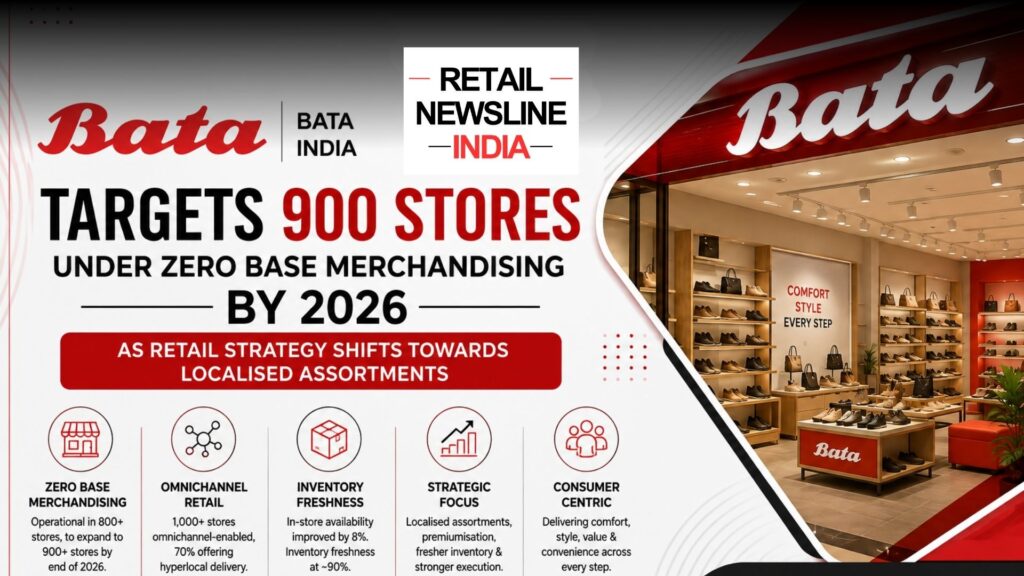
Bata India is reshaping its retail strategy around localised merchandising, fresher inventory, omnichannel fulfilment and premiumisation, with its Zero Base Merchandising (ZBM) programme expected to cover more than 900 stores by the end of 2026.
Bata India is entering its next phase of retail growth with a sharper focus on store productivity, consumer-led merchandising and digital integration, rather than relying solely on expanding its physical footprint.
The footwear major, which operates more than 2,000 brand outlets across India, outlined the strategy at its 93rd Annual General Meeting, highlighting initiatives aimed at improving product relevance, inventory freshness, availability and customer engagement.
A key component of the transformation is Zero Base Merchandising (ZBM), a retail strategy that uses local demand signals and store-level consumer behaviour to determine the products and quantities that should be stocked at individual locations.
According to Bata India, ZBM is already operational across more than 800 stores and is expected to expand to over 900 stores by the end of 2026.
The move represents a shift from a largely standardised store assortment towards a more localised retail model, where merchandise is increasingly aligned with the preferences and demand patterns of individual markets.
Bata India Expands Zero Base Merchandising Across Its Retail Network
Bata’s Zero Base Merchandising strategy is designed to make individual stores more responsive to their local catchments.
Instead of treating every store with a similar product mix, the approach allows assortment decisions to be influenced by factors such as local demand, product performance and consumer preferences.
For a retailer operating thousands of stores across cities and towns with significantly different consumer profiles, this can help address one of the biggest challenges in large-format retail: having the right product available at the right store at the right time.
Bata currently has ZBM implemented across more than 800 stores and plans to take the programme beyond 900 stores by the end of 2026.
The initiative is also part of the company’s broader effort to improve inventory productivity and reduce merchandise clutter at stores.
Inventory Freshness Emerges as a Major Retail Focus
Bata India is also placing greater emphasis on inventory freshness.
The company said in-store availability has improved by 8% in India, while inventory freshness has increased from the mid-70% range to approximately 90%.
The improvement has been supported by season-to-season new-to-store product resets, enabling stores to introduce newer merchandise and respond more quickly to changes in consumer preferences.
For a footwear retailer, inventory freshness is particularly important because consumer demand can change with seasons, fashion trends, occasions and evolving preferences around comfort and styling.
Bata’s strategy therefore combines localised merchandising with more frequent product refreshes to improve the overall store proposition.
From Mass Footwear to Premiumisation and Contemporary Products
Bata is also working to evolve its product portfolio as Indian footwear consumers increasingly seek a combination of comfort, style, value and convenience.
The company is balancing its legacy brand strength with a more contemporary product strategy across its portfolio.
Key brands include:
- Bata
- Hush Puppies
- Power
- Floatz
- Comfit
The strategy involves strengthening product excellence, contemporary styling, comfort and value while making the overall portfolio more relevant to younger and digitally influenced consumers.
This is significant as India’s footwear market becomes increasingly competitive, with established footwear companies competing not only with traditional brands but also with fashion-led, digital-first and direct-to-consumer players.
Bata’s 2,000+ Store Network Becomes an Omnichannel Asset
Bata India’s physical retail footprint is increasingly being integrated with its digital ecosystem.
The company operates more than 2,000 brand outlets in India, supported by more than 775 franchise stores, multi-brand distribution, its direct-to-consumer platforms and online marketplaces.
More than 1,000 Bata stores are now omnichannel-enabled, while approximately 70% of its stores can offer hyperlocal delivery.
This gives Bata an opportunity to use its physical network not simply as a sales channel but also as part of its fulfilment infrastructure.
Stores can increasingly serve as local inventory points, allowing the company to connect offline availability with online demand and potentially shorten fulfilment times.
The combination of physical stores, D2C channels, marketplaces and hyperlocal delivery is becoming an important component of Bata India’s retail strategy.
Bata Moves From Store Expansion to Store Productivity
One of the biggest takeaways from Bata India’s strategy is the increasing emphasis on productivity from existing stores.
For years, retail expansion has been one of the primary ways companies increase their physical presence. However, as retail networks become larger, improving the performance of existing stores can become equally important.
Bata’s approach combines:
- Localised product assortments
- Zero Base Merchandising
- Improved inventory availability
- Faster merchandise refreshes
- Omnichannel integration
- Hyperlocal delivery
- Portfolio premiumisation
- Contemporary product development
- Stronger digital engagement
This indicates a broader shift from a simple “more stores” strategy to a “better stores” strategy.
Bata India Focuses on Younger and Digitally Influenced Consumers
The Indian footwear market is witnessing a significant change in consumer behaviour.
Younger consumers increasingly discover products online, compare prices digitally, follow fashion trends on social platforms and expect convenience across both online and offline channels.
Bata is responding by strengthening its marketing and storytelling while attempting to make its brands more relevant to younger consumers.
The company is seeking to maintain the trust and recognition associated with its legacy brands while introducing contemporary styles, improved value propositions and stronger digital engagement.
This balancing act could be important for Bata as it competes across multiple consumer segments.
FY26 Financial Performance Remains Largely Flat
Bata India’s retail transformation comes against a relatively subdued financial backdrop.
The company reported standalone turnover of ₹3,515.48 crore in FY26, compared with ₹3,488.03 crore in the previous year, representing growth of approximately 0.79%.
On a consolidated basis, turnover stood at ₹3,515.50 crore.
Profitability was affected by exceptional and one-off costs totalling ₹71.41 crore.
These included:
- ₹42.37 crore towards a voluntary retirement scheme
- ₹22.37 crore non-cash forex loss following sharp currency depreciation
- ₹6.67 crore related to the new Labour Codes
The numbers underline why improving retail productivity, inventory efficiency and store-level performance remains important for Bata as it enters its next phase of growth.
Bata India Approves 180% Final Dividend
Bata India has also approved a final dividend of 180%, in line with its Dividend Distribution Policy.
The company’s wider corporate initiatives during the year included social programmes that reached more than 9,200 students, supported by over 7,000 hours of employee volunteering.
While these initiatives sit outside the company’s core retail strategy, they form part of Bata India’s broader corporate and community agenda.
Ashwani Windlass: Focus on Competitiveness and Agility
Bata India Chairman Ashwani Windlass described FY26 as a year of purposeful transformation for the company.
The company’s stated priorities include strengthening competitiveness, improving agility and preparing the business for sustainable growth.
The focus areas include:
Product excellence: Developing products that meet changing consumer requirements.
Contemporary styling: Making the portfolio more relevant to current fashion preferences.
Enhanced comfort: Continuing to strengthen comfort-led footwear propositions.
Superior value: Improving the value equation for consumers.
The company also highlighted diversified sourcing, disciplined inventory management and agile execution as important factors in navigating a challenging external environment.
What Bata India’s Retail Strategy Means for Indian Footwear Retail
Bata India’s strategy reflects a larger transformation underway across Indian retail.
The next phase of retail growth is increasingly being driven by data-led assortment planning, inventory productivity, omnichannel retail and customer-level personalisation.
For Bata, the ZBM programme could become particularly important because of the scale and diversity of its retail network.
A store located in a major metropolitan market may have very different customer preferences from one operating in a Tier-II or Tier-III city. A localised merchandising system allows retailers to respond to those differences rather than relying on a uniform assortment.
At the same time, the integration of stores with digital channels allows the company to extract more value from its existing physical footprint.
Bata’s 2026 Retail Strategy: Key Takeaways
Bata India’s retail strategy for 2026 can be summarised through five major priorities:
1. Expand Zero Base Merchandising:
ZBM is expected to reach more than 900 stores by the end of 2026.
2. Improve inventory freshness:
Bata has increased inventory freshness to around 90%, supported by regular product resets.
3. Strengthen omnichannel retail:
More than 1,000 stores are omnichannel-enabled and around 70% can support hyperlocal delivery.
4. Modernise the product portfolio:
Brands such as Hush Puppies, Power, Floatz, Comfit and Bata are being positioned around contemporary styling, comfort and value.
5. Increase productivity from the existing network:
The company is increasingly focused on extracting greater value from its large store base rather than depending only on physical expansion.
The Road Ahead for Bata India
Bata India’s next growth phase is likely to be defined less by the number of stores it operates and more by how effectively each store responds to its local market.
The planned expansion of Zero Base Merchandising to more than 900 stores represents a significant step in that direction.
With inventory freshness approaching 90%, more than 1,000 omnichannel-enabled stores and hyperlocal delivery capabilities across a large portion of its network, Bata is building an increasingly connected retail ecosystem.
The challenge now will be translating these operational improvements into stronger sales growth, improved store productivity and sustainable profitability.
For one of India’s most established footwear retailers, the strategy signals a clear shift: from scale-led retail to smarter, more localised and digitally connected retail.
Frequently Asked Questions
What is Bata India’s Zero Base Merchandising strategy?
Zero Base Merchandising, or ZBM, is Bata India’s store-level merchandising approach that uses local demand signals to determine product assortments for individual stores.
How many Bata stores currently use Zero Base Merchandising?
Bata India said Zero Base Merchandising is operational across more than 800 stores.
How many Bata stores will use ZBM by 2026?
Bata India expects Zero Base Merchandising to reach more than 900 stores by the end of 2026.
How many Bata stores are there in India?
Bata India operates more than 2,000 brand outlets across India, supported by franchise stores and other distribution channels.
How many Bata stores are omnichannel-enabled?
More than 1,000 Bata stores are currently omnichannel-enabled.
What is Bata India’s inventory freshness?
Bata India said inventory freshness has improved to around 90%, compared with the mid-70% range previously.
Which brands are part of Bata India’s portfolio?
Bata India’s portfolio includes Bata, Hush Puppies, Power, Floatz and Comfit, among others.
What was Bata India’s FY26 turnover?
Bata India’s standalone turnover for FY26 was ₹3,515.48 crore, while consolidated turnover was ₹3,515.50 crore.