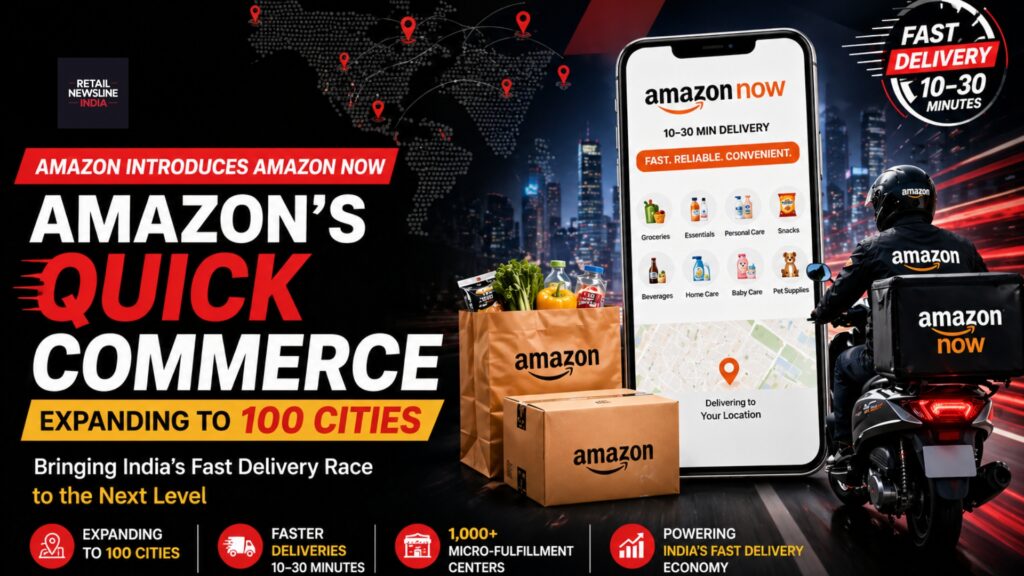
In a significant move that underscores the intensifying competition in India’s quick commerce landscape, Amazon has announced plans to expand its rapid delivery services to 100 cities across India. This development positions the global e-commerce giant more aggressively against fast-growing players like Blinkit, Zepto, and Swiggy Instamart, all of whom have been redefining consumer expectations around instant delivery.
As quick commerce continues to reshape India’s retail ecosystem, Amazon’s expansion marks a pivotal shift in strategy—from traditional e-commerce timelines to ultra-fast, hyperlocal fulfillment models.
Amazon’s Quick Commerce Expansion: What It Means
Amazon’s decision to scale its quick commerce operations to 100 cities reflects a broader transformation in consumer behavior—where speed, convenience, and reliability are becoming non-negotiable.
The company has been steadily piloting ultra-fast delivery formats, including same-day and sub-2-hour deliveries, across select urban markets. With this expansion, Amazon aims to bring:
- Faster delivery timelines (10–30 minutes in select zones)
- Hyperlocal fulfillment through dark stores
- Expanded product assortment including groceries, essentials, and daily-use items
- Improved last-mile logistics efficiency
This move is not just about speed—it’s about owning the “instant consumption” moment, which is increasingly dominated by quick commerce platforms.
The Rise of Quick Commerce in India
India’s quick commerce segment has witnessed explosive growth over the past few years, driven by urban lifestyles, smartphone penetration, and evolving consumption habits.
Key industry trends include:
- Consumers shifting from weekly bulk purchases to frequent small-ticket orders
- Rising demand for instant grocery delivery, snacks, personal care, and essentials
- Increased reliance on mobile-first ordering experiences
- Growth in impulse buying driven by fast delivery promises
Platforms like Blinkit, Zepto, and Swiggy Instamart have capitalized on these trends by building dense networks of dark stores and optimizing delivery logistics.
Amazon’s entry at scale signals that quick commerce is no longer a niche—it’s becoming mainstream retail infrastructure.
Strategic Drivers Behind Amazon’s Expansion
1. Competing in a High-Growth Segment
Quick commerce is one of the fastest-growing segments in India’s retail market. By expanding to 100 cities, Amazon is ensuring it doesn’t lose market share to specialized players.
2. Strengthening Hyperlocal Capabilities
Amazon is investing in micro-fulfillment centers and dark stores, enabling faster deliveries and better inventory management tailored to local demand patterns.
3. Enhancing Prime Value Proposition
For Amazon Prime members, faster deliveries add significant value, increasing retention and engagement.
4. Leveraging Existing Logistics Network
Unlike startups, Amazon already has a vast logistics and warehousing network, giving it a strong foundation to scale quick commerce efficiently.
Impact on India’s Retail & E-commerce Ecosystem
Amazon’s aggressive push into quick commerce is expected to have far-reaching implications:
Increased Competition
Existing players like Blinkit, Zepto, and Swiggy Instamart will face intensified competition, especially in Tier 1 and Tier 2 cities.
Faster Industry Evolution
The expansion will accelerate innovation in:
- Delivery speed
- Inventory optimization
- Customer experience
- Pricing strategies
Boost for D2C Brands
Quick commerce platforms are becoming critical channels for D2C brands, offering:
- Faster market access
- Higher product visibility
- Increased impulse purchases
Growth in Tier 2 & Tier 3 Markets
Amazon’s scale will help bring quick commerce to emerging cities, unlocking new demand pockets.
Challenges Amazon May Face
While the opportunity is massive, scaling quick commerce comes with challenges:
- High operational costs due to last-mile delivery
- Inventory management complexities at hyperlocal levels
- Thin margins in grocery and essentials
- Infrastructure limitations in smaller cities
However, Amazon’s deep pockets and technological capabilities position it well to navigate these challenges.
The Bigger Picture: Evolution of E-commerce
Amazon’s expansion highlights a critical shift:
E-commerce is no longer just about selection and price—it’s about speed and convenience.
The lines between:
- E-commerce
- Quick commerce
- Offline retail
are rapidly blurring, creating a unified omnichannel retail ecosystem.
Future Outlook
Looking ahead, Amazon’s quick commerce strategy could evolve further through:
- AI-driven demand forecasting
- Drone or autonomous delivery pilots
- Expansion into fresh food and pharmacy segments
- Deeper integration with local sellers and kirana stores
If executed effectively, Amazon could redefine the competitive dynamics of India’s retail market.
Frequently Asked Questions
What is Amazon Now?
Amazon Now is Amazon’s quick commerce service offering ultra-fast delivery of daily essentials within minutes.
How many cities will Amazon expand to?
Amazon plans to expand its quick commerce service to 100 cities across India.
What infrastructure supports this expansion?
The expansion is powered by 1,000+ micro-fulfilment centres across the country.
Who are Amazon’s competitors in quick commerce?
Major competitors include Blinkit, Zepto, and Swiggy Instamart.