
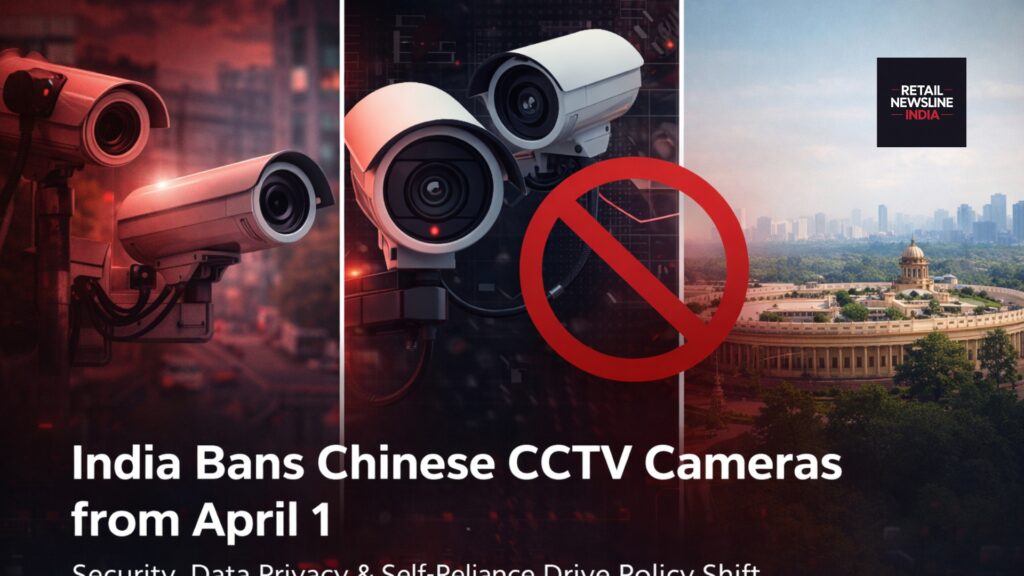
In a major policy shift impacting India’s surveillance and security ecosystem, the government has effectively barred Chinese video surveillance companies like Hikvision and Dahua from selling internet-connected CCTV cameras in the country starting April 1.
The move comes after authorities declined certification under the Standardisation Testing and Quality Certification (STQC) framework for products manufactured in China or those using Chinese chipsets. This decision is expected to significantly reshape India’s fast-growing CCTV market.
STQC Certification Rules Reshape India’s CCTV Market
The STQC certification mandate now requires stringent testing and approval for all surveillance equipment, particularly those connected to the internet.
Key implications of the new rules include:
- Denial of certification for Chinese-origin hardware
- Restrictions on products using Chinese chipsets
- Enhanced focus on cybersecurity and data protection
- Push for trusted and localized supply chains
Industry executives believe this effectively eliminates Chinese brands from a market where they once accounted for nearly one-third of total sales.
Indian Brands Capture Over 80% Market Share
The exit of Chinese players has triggered a rapid shift in market dynamics, with Indian manufacturers stepping in to fill the gap.
Leading domestic brands include:
- CP Plus
- Qubo
- Prama
- Matrix
- Sparsh
According to market insights, Indian companies now command over 80% of the CCTV market, marking a dramatic increase in domestic dominance.
Notably, CP Plus has emerged as the clear leader, capturing 45–50% market share, up from 20–25% prior to the regulatory changes.
Supply Chain Shift: From China to Taiwan & Beyond
To comply with new regulations, Indian brands have rapidly restructured their supply chains by:
- Switching to Taiwanese chipsets
- Adopting non-Chinese hardware components
- Developing localized firmware systems
- Strengthening domestic assembly and manufacturing
This transition supports India’s broader goal of supply chain diversification and self-reliance in critical technology sectors.
Global Players Target Premium Segment
While Indian brands dominate the mass and mid-market segments, global players such as:
- Bosch
- Honeywell
have strengthened their hold in the premium surveillance segment, leveraging advanced technology and enterprise-grade solutions.
Exit of Smartphone Brands and Smaller Players
The stricter certification norms have also impacted:
- Smartphone brands like Xiaomi and Realme
- Smaller traders and import-dependent sellers
Many of these players have exited the smart camera segment due to:
- Certification challenges
- Increased compliance costs
- Supply chain disruptions
Hikvision and Dahua Face Sharp Decline
The regulatory crackdown has significantly impacted Chinese incumbents:
- Hikvision
- Denied certification for a major manufacturing facility
- Capacity of up to 2 million cameras per month affected
- Exploring joint ventures with Indian firms
- Dahua
- Business reportedly declined by 80%
- Limited to selling analog cameras, which are rapidly becoming obsolete
Rising Costs and Pricing Pressure
The shift away from Chinese components has led to increased production costs across the industry.
Key cost impacts:
- 15–20% increase in Bill of Materials (BoM)
- Higher chipset costs from Taiwanese and U.S. suppliers
- Increased R&D and localization expenses
Market impact:
- Entry-level camera prices remain relatively stable
- Mid and premium segments witnessing price hikes
- Businesses and institutions facing higher upgrade costs
Strategic Implications for India’s Security Ecosystem
The move aligns with India’s broader strategic priorities:
🇮🇳 Digital Security
Reducing dependence on foreign surveillance systems
🔗 Supply Chain Independence
Encouraging local manufacturing and trusted sourcing
📈 Domestic Industry Growth
Boosting Indian brands and innovation
⚠️ Challenges
- Higher costs may impact adoption rates
- Technology gap in high-end segments
- Need for continued R&D investment
Why This Move Matters
This development marks a turning point for India’s surveillance market:
✔️ Domestic brands gain unprecedented market control
✔️ Reduced reliance on Chinese technology
✔️ Strengthened cybersecurity framework
✔️ Accelerated “Make in India” momentum
However, balancing cost, innovation, and scale will be critical for sustained growth.
Conclusion
India’s decision to restrict Chinese CCTV giants like Hikvision and Dahua under the STQC framework is a landmark shift in the country’s security and technology landscape. While it opens massive opportunities for domestic manufacturers, it also introduces new challenges around cost and technological competitiveness.
The coming years will determine whether Indian brands can scale innovation alongside market dominance, solidifying India’s position as a global hub for surveillance technology.
Frequently Asked Questions (FAQs)
Q1. Why has India banned Hikvision and Dahua CCTV cameras?
India has restricted these brands due to STQC certification rules that limit products made in China or using Chinese chipsets, primarily for security and data protection concerns.
Q2. Which companies are benefiting from the ban?
Indian brands like CP Plus, Qubo, and Prama are gaining significant market share.
Q3. What is STQC certification in India?
STQC (Standardisation Testing and Quality Certification) is a government certification ensuring quality, safety, and cybersecurity compliance of electronic products.
Q4. How has the CCTV market changed in India?
Indian companies now control over 80% of the market, compared to Chinese brands previously holding around one-third share.
Q5. Will CCTV prices increase in India?
Yes, especially in mid and premium segments, due to higher costs of non-Chinese components.