
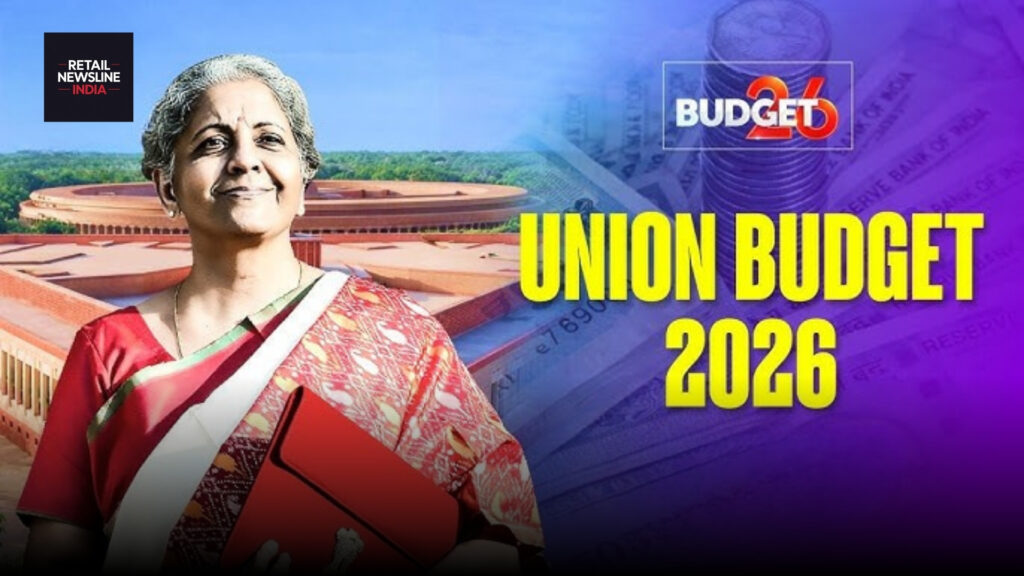
The Union Budget 2026–27, presented by Finance Minister Nirmala Sitharaman in the Lok Sabha, outlines the Government of India’s fiscal strategy for the coming financial year with a strong emphasis on infrastructure investment, manufacturing-led growth, fiscal consolidation, and sectoral rationalisation. With a total expenditure of ₹53.5 lakh crore, the Budget seeks to balance economic growth with long-term financial stability.
While the Budget reinforces capital expenditure as the primary growth engine, sector-wise allocations reveal notable adjustments—particularly for the Ministry of Information and Broadcasting (I&B)—and have triggered renewed debate on the lack of explicit focus on school education.
Union Budget 2026–27: Macro-Fiscal Snapshot
The Budget continues the government’s medium-term fiscal consolidation roadmap while sustaining public investment.
Key Fiscal Indicators
- Total Budget Size: ₹53.5 lakh crore
- Capital Expenditure (Capex): ₹12.2 lakh crore (4.4% of GDP)
- Fiscal Deficit Target: 4.3% of GDP
- Defence Allocation: ₹7.8 lakh crore
- Net Market Borrowings: ₹11.7 lakh crore
The sustained capex allocation highlights the government’s strategy of crowding in private investment, creating jobs, and strengthening long-term productive capacity.
Ministry of Information and Broadcasting Budget 2026–27
The Ministry of Information and Broadcasting has been allocated ₹4,551.94 crore in the Union Budget 2026–27.
This represents a reduction from the revised estimate of ₹6,103.02 crore in FY 2025–26, reflecting expenditure rationalisation and reprioritisation within the ministry.
Despite the overall reduction, key operational and strategic areas—such as public broadcasting, media outreach, and broadcasting infrastructure—continue to receive targeted funding.
Prasar Bharati Allocation and Role in Budget 2026
Prasar Bharati, India’s public service broadcaster overseeing Doordarshan and All India Radio (AIR), has been allocated ₹2,291.88 crore for FY 2026–27.
Purpose of Allocation
- Salaries and pensions of employees
- Day-to-day operational expenditure
- Maintenance of broadcast infrastructure
- Content dissemination across television, radio, and digital platforms
The allocation underscores the government’s continued reliance on Prasar Bharati as a key vehicle for public communication, cultural programming, and national outreach.
Information and Publicity Spending Sees Increase
Despite the overall cut to the ministry’s budget, expenditure on information and publicity has been increased.
- Allocation: ₹1,476.83 crore
- Revised Estimate (2025–26): ₹1,207.67 crore
This increase reflects the growing importance of government communication across traditional, digital, and regional platforms, particularly in reaching diverse audiences across India.
Broadcasting Infrastructure Network Development (BIND) Scheme
The Budget allocates ₹509.24 crore to the Broadcasting Infrastructure Network Development (BIND) Scheme, compared to a revised estimate of ₹550 crore in the previous year.
Key Objectives of the BIND Scheme
Implemented through Prasar Bharati, the scheme focuses on:
- Digitalisation and FMisation of the All India Radio network
- Expansion of FM radio coverage in remote and underserved areas
- Upgradation of Direct-to-Home (DTH) broadcasting capacity to carry additional channels
- Improving signal quality, reliability, and viewer experience
The scheme plays a critical role in modernising India’s public broadcasting ecosystem and supporting the community radio movement, which is vital for grassroots communication and local content dissemination.
Support for Government Media Units and AVGC Talent Development
The Union Budget 2026–27 also provides for expenditure across various government media and communication units, including:
- Central Bureau of Communication
- Press Information Bureau (PIB)
- Publications Division
- New Media Wing
- Electronic Media Monitoring Centre
In addition, the Budget continues to support talent development in Animation, Visual Effects, and Gaming (AVGC)—a sector increasingly recognised for its export potential, employment generation, and role in India’s creative economy.
School Education Missing from Budget 2026–27: Expert Reactions
While higher education, skill development, and innovation initiatives find mention in the Budget, school education has emerged as a major point of criticism.
Dr Rahul Mehra, National Representative of India at the UNESCO Chair for Global Health & Education and Executive Chairman of Tarang Health Alliance, expressed strong concern over the absence of school education in the Budget document.
Key Concerns Raised
- No explicit mention of school education despite a Budget document exceeding 15,000 words
- Continued failure to meet NEP 2020 and UNESCO recommendations of allocating 6% of GDP to school education
- Persistent gaps in learning outcomes
- Severe underfunding of teacher training and development
- Limited focus on health education and life skills at the school level
According to Dr Mehra, the education allocation for 2026–27 reflects a status quo approach, rather than the transformational investment required to improve access, quality, and equity in school education.
Budget 2026–27: Sectoral Balance and Policy Signals
The Union Budget 2026–27 sends a clear signal of continuity in macroeconomic policy—prioritising infrastructure, manufacturing, and fiscal discipline. However, the reduced allocation for the Information and Broadcasting Ministry and the absence of targeted school education reforms highlight the trade-offs inherent in fiscal decision-making.
While investments in public broadcasting infrastructure, AVGC talent development, and community radio strengthen India’s media and cultural ecosystem, experts caution that long-term economic growth must be supported by strong foundational education systems.
Conclusion: What Budget 2026–27 Indicates
The Union Budget 2026–27 positions capital expenditure and infrastructure as the primary levers of economic growth, while maintaining a disciplined fiscal stance. At the same time, it raises important questions about sectoral priorities—particularly in media funding allocation and the future of school education reform.
As implementation unfolds, the effectiveness of these allocations will depend on execution, inter-ministerial coordination, and the government’s ability to balance growth with inclusive human capital development.